
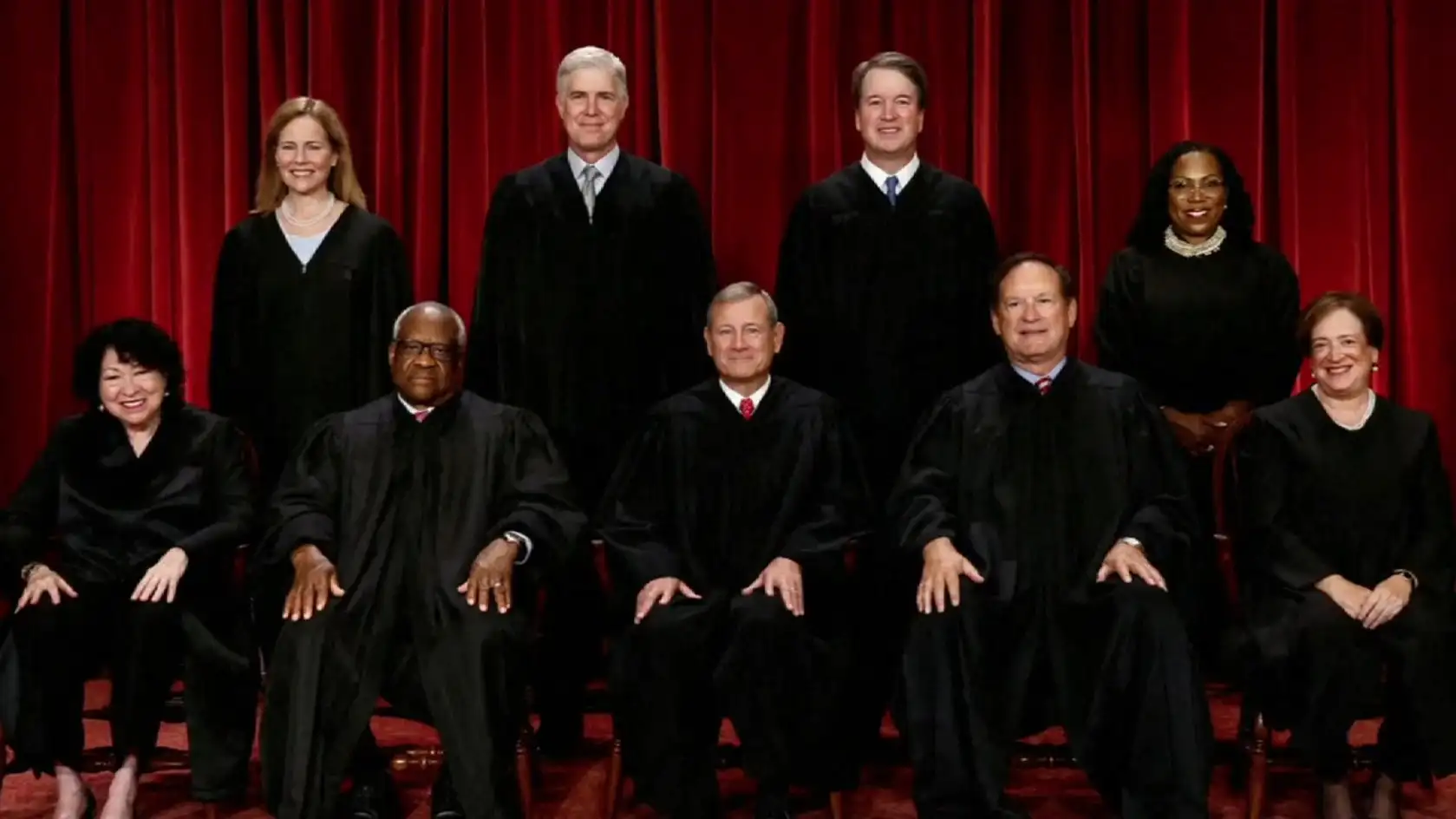
The U.S. Supreme Court has ruled that children born on American soil are citizens under the Fourteenth Amendment, even when their parents are in the country unlawfully or only temporarily. The decision, however, highlighted deep philosophical and historical divisions among the justices — most notably a pointed exchange in reasoning between Justice Clarence Thomas and Justice Ketanji Brown Jackson.
What the Court decided
The majority held that birth on U.S. soil combined with being subject to U.S. law is sufficient to confer citizenship under the Citizenship Clause of the Fourteenth Amendment. The majority opinion emphasized the role of birthplace in traditional common law and framed the Clause as extending the promise of rights to “every free-born person in this land.”
Majority and dissenting views
Chief Justice John Roberts wrote much of the majority opinion, grounding his analysis in English common-law principles and historic understandings of nationality that prioritize place of birth over parental immigration status or domicile. “We keep that promise today,” Roberts said in explaining the court’s holding.
In dissent, Justice Clarence Thomas argued for a narrower originalist reading. Thomas said the Citizenship Clause historically applied to those who were born in the country and who “called it home,” relying on Reconstruction-era debates to suggest that citizenship could depend on a parent’s more enduring relationship or domicile in the United States. Thomas concluded that the executive order at issue — which attempted to limit birthright citizenship for children of parents in the U.S. unlawfully or temporarily — is not necessarily unconstitutional on its face.
Jackson’s response and the Reconstruction context
Justice Ketanji Brown Jackson, who joined the majority, wrote separately to respond directly to Thomas’ dissent. Jackson argued that Thomas misreads the Reconstruction Amendments and understates their broad remedial purpose. Where Thomas characterized the Citizenship Clause as focused on a particular group (for example, freed slaves who had a domicile), Jackson described the Reconstruction Amendments as an “anti-caste, anti-subordination reset for the Nation,” not merely a targeted remedy for a single historical wrong. Her response underscored a fundamental philosophical rift over how to interpret Reconstruction-era intent and the Clause’s scope.
Political and legal implications
The ruling rejects an executive order issued at the start of a presidential term that sought to limit birthright citizenship. Practically, the decision preserves longstanding legal expectations for the children born on U.S. soil and reduces immediate uncertainty for those families and for public policy that depends on clear rules for citizenship.
But the opinions also signal continuing fault lines on the court about constitutional interpretation, originalism, and how to weigh historical sources like Reconstruction debates. Those fault lines could affect how the court approaches other major questions dealing with immigration, equal protection, and the remedial reach of the Reconstruction Amendments.
What to watch next
- Lower courts and federal agencies will look to the Supreme Court’s reasoning to guide implementation and enforcement of citizenship rules.
- Future litigation may test related immigration policies, statutes, or executive actions that attempt to condition citizenship on factors beyond birthplace and subjection to U.S. law.
- The opinion may be cited in future cases addressing the scope of Reconstruction-era protections and how historical evidence should inform modern constitutional interpretation.
Sources
- Associated Press coverage of the decision (source material provided)
- Supreme Court opinions and filings (see the Supreme Court website for full texts): https://www.supremecourt.gov/
- General background on the Fourteenth Amendment and Reconstruction-era debates: https://www.archives.gov/founding-docs/amendments-11-27
Reporting in this article is based on the provided Associated Press feed and the text of the opinions as released by the Court. For the full majority and dissenting opinions, consult the Supreme Court’s official publications.