

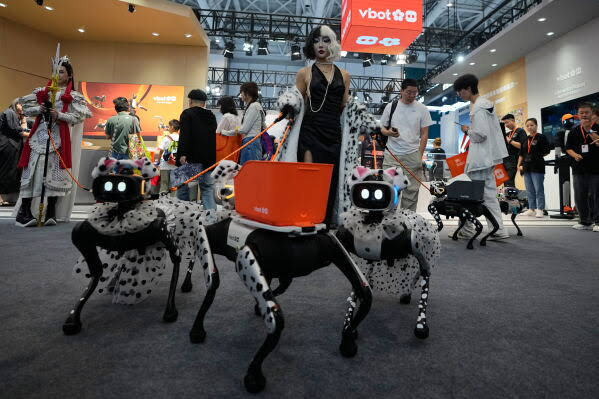
Beijing’s five-day World Robot Conference showcased a broad cross-section of China’s robotics ecosystem, from dancing humanoids and ping-pong-playing quadrupeds to industrial manipulators designed for factory floors. The event illustrated both how far robotic demonstrations have come and how much work remains for robots to deliver reliable real‑world utility.
Highlights from the show floor
Exhibitors filled hundreds of booths with roughly 3,000 products on display. Some of the most attention-grabbing demonstrations included humanoid robots that danced, boxed and even played table tennis with human partners, high‑performance quadruped platforms, and industrial arms showing pick‑and‑place and part‑handling tasks resembling factory workflows. Several companies also marketed humanoid “emotional‑care” models with expressive faces and voice interaction aimed at consumers and care settings. Reported price points for some advanced civilian humanoids ran into the tens of thousands of U.S. dollars.
From spectacle to substance — the commercialization challenge
Despite striking demos, many routine physical tasks remain difficult for general‑purpose humanoid systems. At one booth a robot spent several minutes trying, and ultimately failing, to fold a simple shirt — a telling reminder that agile, adaptable manipulation and robust perception in everyday environments are still unsolved engineering problems.
By contrast, purpose‑built industrial robots, fixed automation and collaborative robot arms continue to deliver reliable productivity gains on factory floors. This suggests the near‑term commercial opportunity lies less with general humanoids and more with domain‑specific robots that solve narrowly defined problems at scale.
Market signals and geopolitical headwinds
The World Robot Conference also coincided with notable market and policy developments. One major Chinese robotics firm marked a stock market debut during the event, signaling investor appetite for robotics plays despite the sector’s technical hurdles. At the same time, regulators abroad are moving to restrict imports of advanced robotic systems over security concerns, a dynamic that will shape global supply chains and market access.
Policy and security considerations
Policymakers in several countries have flagged advanced robots as potential national security and cybersecurity risks, particularly humanoids and autonomous platforms that could be used in sensitive environments or integrated into critical infrastructure. These concerns have prompted import restrictions and export‑control conversations that could fragment markets, limit cross‑border collaboration and spur domestic substitution strategies.
What to watch next
- Commercial adoption vs. demonstrations: Which vendors translate impressive demos into dependable field deployments for hospitals, factories and logistics?
- Regulatory developments: Will export controls, import bans, or new safety/cyber rules reshape global competition and supply chains for advanced robots?
- Investment and consolidation: Will capital continue to flow into specialty robotic niches while general‑purpose humanoid ventures face higher technical and commercial scrutiny?
- Human factors and ethics: How will developers validate claims about ‘‘emotional‑care’’ robots, protect user data, and set realistic expectations for vulnerable users?
Implications — balance of opportunity and realism
The Beijing conference underlined China’s ambition to move robotics beyond stagecraft and into scaled applications. But the technology’s maturity remains uneven: high reliability in constrained industrial settings versus ongoing limitations in dexterous, general‑purpose manipulation and genuinely autonomous social interaction. Expect a continued bifurcation over the next several years: steady industrial and logistics automation growth, cautious consumer adoption of specialized helpers, and intense geopolitical attention on advanced systems that cross security thresholds.
Sources and further reading
Primary reporting on the conference and product demonstrations is summarized in an Associated Press dispatch. Company information and product lines can be found on the websites of leading robotics firms. For policy context on import and security measures, see official regulatory communications from national agencies.
Selected references
- Associated Press — coverage of the World Robot Conference
- Unitree Robotics — company and product pages
- UBTECH Robotics — company and product pages
- Federal Communications Commission — official site (policy and national‑security communications)
If you plan to publish this on WordPress: the above content is provided as HTML for direct copy/paste. Consider adding a featured image of the conference floor and linking directly to any company press releases or the AP story you prefer to cite for specific quotes or figures.