

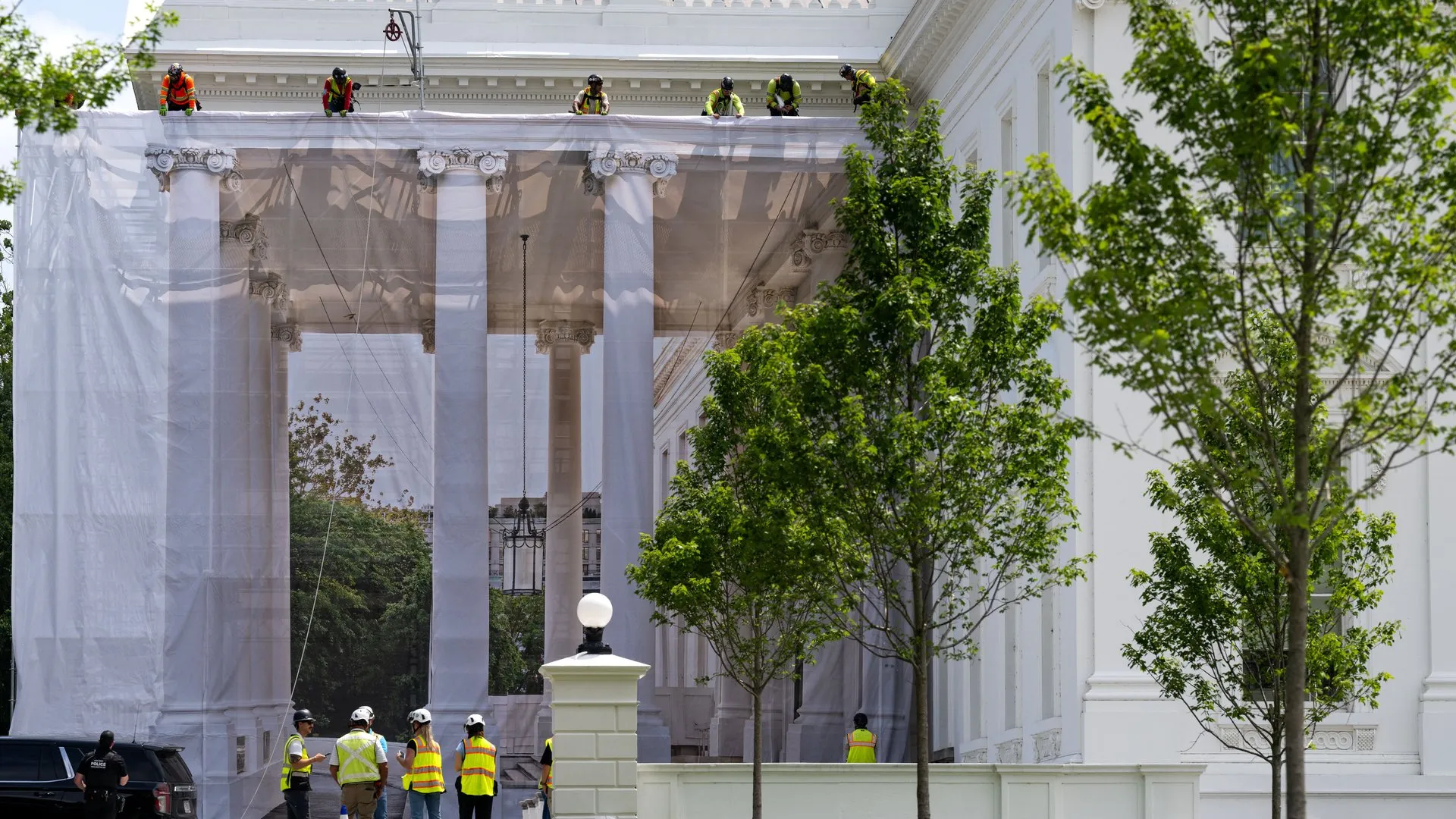
What unfolded at the North Portico
In late June and early July, work crews erected scaffolding and unrolled a photographic drape over the White House North Portico while contractors carried out what officials are calling stone and column rehabilitation. The coverings included a printed image that mirrors the look of the columns beneath them — a move that made the work immediately visible to passersby and photojournalists.
Timeline and visible actions
- Earlier work: Contractors reportedly spent weeks preparing the columns, including paint-stripping operations that sources say began in early June.
- Recent activity: In late June a worker was seen removing a lantern beneath the overhang; in early July scaffolding and the drape were put in place, bringing the project into plain view.
- Public remarks: President Donald Trump and Interior Secretary Doug Burgum publicly addressed the work — Trump characterized the effort as removing layers of old paint and reshaping the columns, while Burgum credited the president’s attention to detail for accelerating the project.
How officials describe the work
The White House has described the effort as routine restoration and “stone repair to the columns,” emphasizing preservation and rehabilitation rather than alteration. Administration officials framed the work as cosmetic and structural upkeep of a prominent public building.
Context: one of several White House and D.C. projects
The column rehabilitation is one piece of a broader set of installations and modifications reported at the White House and around Washington, D.C., including ongoing ballroom work, new signage above the West Wing, and the high-profile proposal for a 250-foot triumphal arch near the capital. That arch proposal has drawn federal review and discussion about whether local building-height regulations apply.
Policy and preservation questions
Two themes are central to the public conversation:
- Historic preservation vs. aesthetic change: Rehabilitation of historic elements on the White House raises routine questions about preservation standards, the appropriate conservation methods (for example, how much paint to strip from historic masonry or columns), and the role of professional conservators and federal preservation guidelines.
- Oversight and approvals: Proposed larger-scale projects — like the suggested triumphal arch — invoke review by federal planning and design bodies. Debate has arisen over which rules and laws apply, including whether Washington’s Height of Buildings Act and federal design-review standards should govern the siting and scale of new monuments and structures in the capital.
What to watch next
- Official project scope and cost disclosures: look for more detailed statements or release of contractor and budget documents that clarify whether the column work is primarily conservation (restoration to a historic appearance) or a reconfiguration involving replacement materials.
- Historic preservation input: statements and technical reviews from preservationists, the National Park Service, and federal design commissions could shape public understanding of whether conservation standards were followed.
- Progress on related proposals: the planning commission reviews and any required permits or legal determinations for larger projects (including the proposed arch) will indicate how design policy and height-limit rules are being interpreted.
Why it matters
Even relatively small restoration projects on iconic federal properties can become focal points for larger debates about stewardship of public heritage, executive priorities for federal property, and how design decisions in the nation’s capital should be reviewed. The visible scaffolding and drape turned what might otherwise have been background maintenance into a public moment — one that prompts questions about transparency, cost, preservation standards and the roles of oversight bodies.
Further reading and sources
- Recent reporting and timeline details: CNN — search results for White House columns scaffolding
- National capital planning and design review context: National Capital Planning Commission (NCPC)
- Background on height limits in Washington, D.C.: Height of Buildings Act of 1910 (overview)
- General coverage of related White House projects and public statements: AP News — White House columns search
Note: This summary synthesizes reporting from mainstream news outlets and publicly available federal planning resources to provide context and an overview suitable for publication. Readers seeking the primary news dispatches can follow the links above for contemporaneous coverage.