

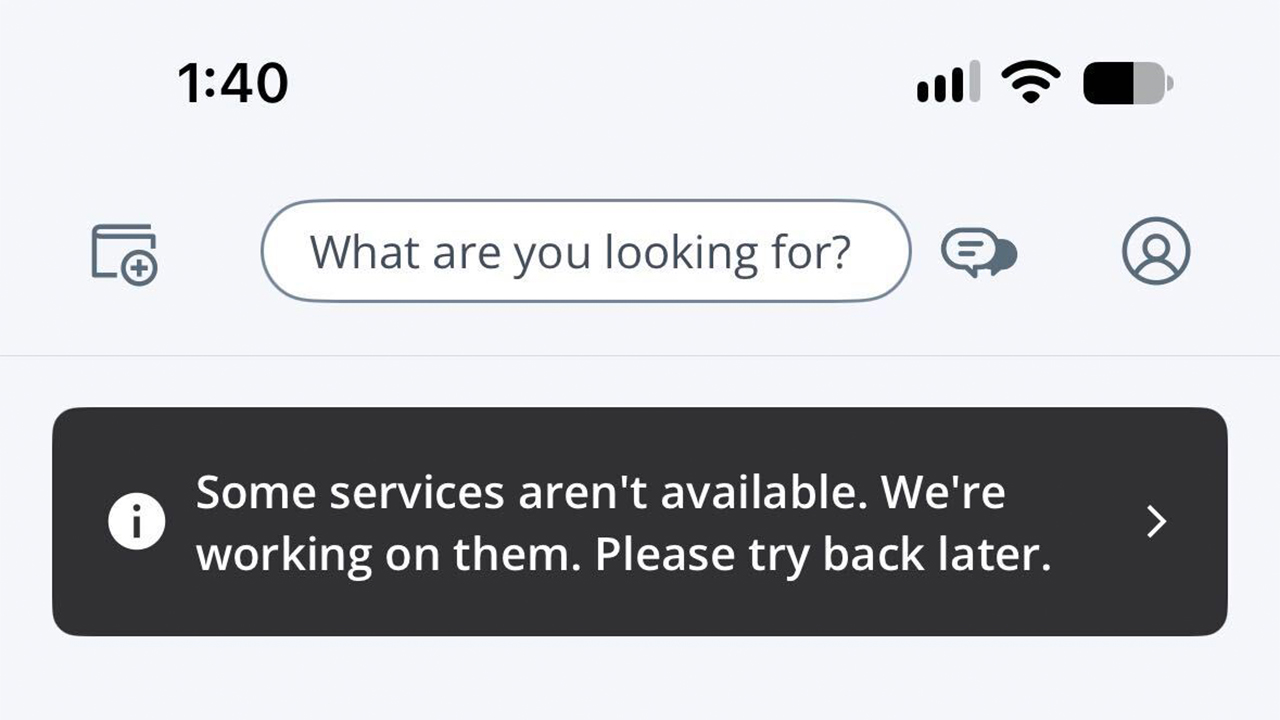
JPMorgan Chase’s online and branch systems experienced an hourslong disruption after a software release earlier Monday affected a subset of the bank’s systems, according to federal and company statements. Customers reported delays and trouble completing transactions; the bank and an FBI official said there was no indication the outage was the result of malicious external cyber activity. Systems were reported to be coming back online by mid-to-late afternoon.
What happened
Beginning in the morning, customers across the country reported problems accessing accounts, making transfers, and completing transactions that involved JPMorgan Chase as a party. The bank acknowledged an online banking issue through its support channels and posted updates that customers still had access to funds even as some transactions were taking longer than usual to complete.
Bank employees at several branches said in reports to media that branch systems were intermittently up and down, though ATMs and some mobile app functions continued to operate. The disruption was limited to JPMorgan Chase and transactions in which the bank participated; other institutions said their own systems were operating normally, though some customers reported delays in transfers involving Chase as the counterparty.
Attribution and official responses
JPMorgan Chase publicly described the incident as technical and not malicious. An FBI official told reporters the disruption traced to a software release the bank rolled out earlier that day and that there was no indication of external cyber attack. Third-party payment network Zelle said its network was operating normally, noting that banks and credit unions manage consumer accounts and hold funds, while its operator Early Warning Services provides the transfer rails.
Why this matters
- Scale and centrality — As one of the largest U.S. banks, disruption at JPMorgan Chase can ripple into other institutions and payment flows when Chase is the counterparty to transactions, highlighting interdependence within banking infrastructure.
- Software-release risk — The incident underscores how changes pushed to production systems can have outsized operational impacts, even absent malicious activity. Robust change management, testing, staged rollouts, and rapid rollback capabilities are essential for large financial institutions.
- Public confidence and regulation — Repeated or extended outages at major banks raise concerns for customers and can trigger scrutiny from regulators about operational resilience, incident reporting, and contingency planning.
Industry context and recent trends
This outage follows a pattern over recent years in which critical online services — across airlines, cloud providers, and other financial firms — have experienced interruptions tied to software bugs, configuration errors, or platform changes rather than direct cyberattacks. Regulators and industry groups have emphasized resilience: banks are required to maintain operational risk programs and to coordinate with regulators and interbank networks when incidents occur.
Practical guidance for customers
- Verify balances: Customers concerned about individual transactions should check account balances and recent activity via the app, ATM, or by visiting a branch.
- Retain documentation: Keep records of failed or delayed transactions and any communications with the bank to resolve disputes if needed.
- Use alternative channels: If the app or website is unreliable, use in-branch services or ATMs; consider contacting the payee to delay time-sensitive payments until confirmations are received.
Analysis: What banks should learn
The episode highlights several operational best practices banks and large service providers should continuously refine:
- Comprehensive staging and canary releases to limit the blast radius of software changes.
- Automated monitoring and rollback mechanisms that can quickly revert problematic releases.
- Clear customer communications that set expectations and provide timely updates during incidents.
- Cross-institution coordination for payment rails so knock-on effects are managed transparently.
For customers and market watchers, the key takeaway is that even non-malicious technical issues at a major financial institution can produce significant short-term friction across payments and banking services. Ongoing investment in change controls, testing, and incident-response playbooks is necessary to limit recurrence.
Sources and further reading
- Fox Business — coverage of the incident and bank statements
- JPMorgan Chase — official website and customer communications
- Federal Bureau of Investigation — public statements and press resources
- Zelle — network operator information and statements
- Early Warning Services — Zelle’s network operator
- Reuters — reporting on banking outages and industry reactions
- Associated Press — related coverage of payment-network and airline outages
- CNBC — financial markets and operational resilience reporting
- Office of the Comptroller of the Currency (OCC) — regulatory guidance on operational resilience
Note: This article synthesizes bank statements and contemporaneous media reports about the outage and places them in operational and regulatory context for readers. For transaction-specific issues, contact your bank directly.