


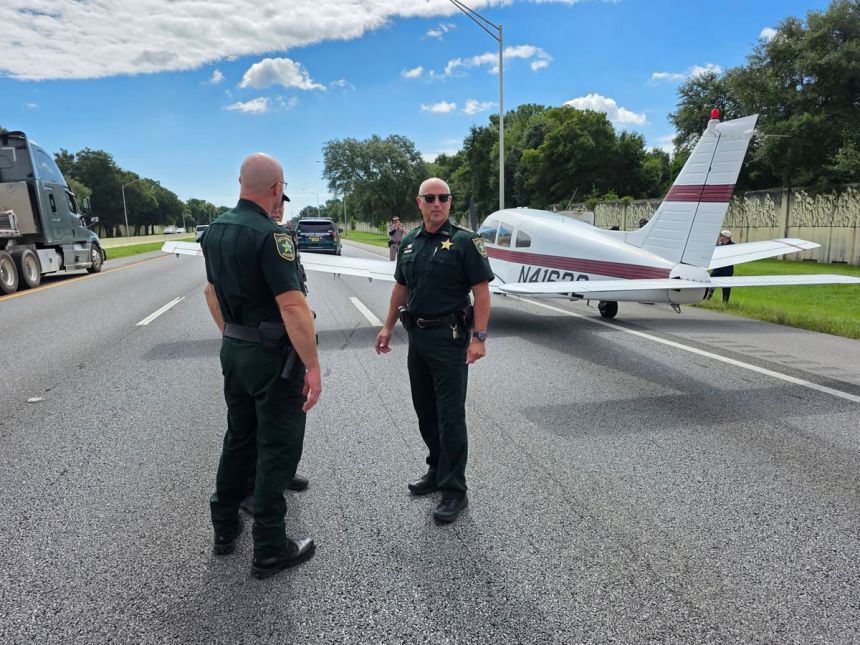
Early Monday morning a small aircraft made an emergency landing on Interstate 10 in Pensacola after the pilot reported engine trouble minutes after departing Pensacola International Airport. According to local reporting, the pilot and a student aboard were able to touchdown on the highway while avoiding moving traffic, then exit the plane safely before it was pushed off the roadway by responding crews.
What happened
Traffic- and eyewitness video shared with local media showed the light aircraft descending between lanes and settling onto the pavement. The pilot reportedly told air traffic that he smelled burning oil and that they would not make it back to the airport, announcing they were going down on I‑10. A nearby truck driver, Eric Jordan, captured the landing on video and helped warn other motorists by activating his hazard lights after the plane came to a stop. No injuries were reported.
Official response and likely next steps
The Florida Highway Patrol (FHP) responded to secure the scene and move the aircraft off the interstate. In cases like this, state troopers and local aviation authorities typically secure the roadway, coordinate removal of the aircraft, and work with federal agencies if an investigation is warranted. The National Transportation Safety Board (NTSB) maintains authority to investigate civil aviation accidents and may open an inquiry if criteria are met; otherwise the Federal Aviation Administration (FAA) or state agencies may handle follow-up.
Why pilots sometimes choose highways in emergencies
When an engine failure occurs shortly after takeoff, pilots must make rapid decisions. Options include attempting to return to the departure airport, landing straight ahead, or selecting an alternate forced-landing site. Open roadways are sometimes chosen because they can provide a relatively long, flat surface with fewer overhead obstructions than nearby fields or neighborhoods. Pilots are trained to prioritize minimizing risk to people on the ground; in this incident, the pilot’s actions and the cooperation of nearby motorists appear to have prevented injuries.
Safety context and takeaways
- Training and decision-making: Single-pilot and instructional flights emphasize emergency procedures, including engine-out checklists and forced-landing options. Thorough preflight inspections and fuel/oil checks reduce risk, but mechanical failures can still occur.
- Communication: Prompt radio calls to air traffic control and clear situational awareness help controllers and emergency responders clear airspace and roadways.
- Motorist behavior: The quick reaction of nearby drivers—slowing, giving space, and helping warn others—can significantly reduce secondary casualties after an emergency landing.
- Investigation: Authorities will examine maintenance history, pilot reports, and available telemetry or witness video to determine probable cause.
Where to find more information
For updates from the original reporting outlet, see WSVN’s coverage of the Pensacola I‑10 landing: wsvn.com. Official agency pages and resources relevant to aviation incidents and safety include the Florida Highway Patrol (flhsmv.gov), the Federal Aviation Administration (faa.gov) and the National Transportation Safety Board’s aviation investigations page (ntsb.gov/aviation).
Final note
While rare, emergency highway landings highlight how training, quick thinking and bystander response can prevent a tragedy. Authorities will release further details as any formal investigation progresses.
Sources: WSVN reporting, Florida Highway Patrol, FAA, NTSB.