




Overview
Apple’s big AI moment at WWDC 2024 — packaged under the name “Apple Intelligence” — was framed as a long-awaited answer to critics who’ve argued Apple has fallen behind rivals when it comes to generative AI. The company rolled out a set of AI-enabled features across iOS, macOS, and its apps, emphasized on-device processing and privacy, and described tighter integration between Apple silicon and AI-powered experiences.
What Apple Announced (High Level)
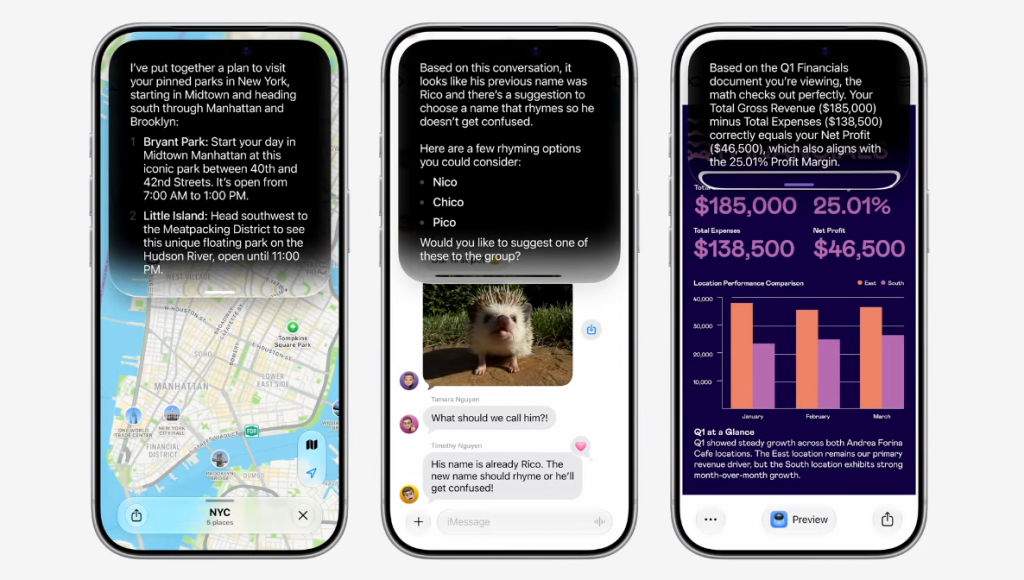
- System-level generative features that assist in Mail, Messages, Notes, Photos, and more.
- Improvements to Siri and new multimodal assistant capabilities.
- On-device AI and model acceleration through Apple silicon and the Neural Engine to reduce latency and enhance privacy.
- Developer tools and APIs to let app makers tap Apple’s new intelligence features and, in some scenarios, connect to cloud models.
Why Some Say Apple Was Behind
By mid-2024, Google, Microsoft, Meta and several startups had moved aggressively with large language models (LLMs), multimodal models, and tangible integrations into search, productivity and platform experiences. Microsoft’s deep partnership with OpenAI and integrations of Copilot across Windows and Office, Google’s rollout of Gemini and integration into Search and Android, and Meta’s progress on open research and model releases gave those companies a visible lead in public-facing generative AI products. Observers said Apple had been more cautious — prioritizing privacy and incremental evolution over high-profile foundation-model bets.
Can Apple’s Approach Close the Gap?
Short answer: it depends on what you measure.
Strengths that play to Apple’s advantage
- Hardware + software integration: Apple can optimize models to run efficiently on its M-series chips and the Neural Engine. That reduces latency and can enable offline capabilities that competitors struggle to match.
- Privacy-first positioning: Apple’s emphasis on local processing and minimizing data sent to servers is a differentiator for privacy-conscious users and enterprises.
- Platform reach and UX polish: Apple controls the tight app and OS ecosystems on iPhone, iPad and Mac, enabling consistent, polished experiences across devices.
- Developer toolchain: If Apple can give developers easy, performant ways to integrate Apple Intelligence into apps while preserving privacy, it can scale its features without building every model itself.
Limitations and headwinds
- Late to market on foundation models: Apple did not previously publish or train foundation models at the scale of OpenAI, Google or Meta. Building or licensing models at that scale takes time and billions of dollars.
- Cloud model relationships and speed: For tasks that require very large models, Apple may need to rely on cloud partners or third-party models — adding complexity, latency, or business frictions.
- Expectation vs. reality: Users have come to expect conversational AI and large-model “wow” moments. Incremental, utility-focused features may be less flashy and get less press attention.
- Regulatory and ecosystem constraints: EU rules and antitrust scrutiny can slow broad rollouts or force restraint in certain integrations.
How to Judge Success — Short Term vs Long Term
Short-term wins for Apple will look like: smooth, genuinely useful features that feel integrated and fast; measurable user engagement uplift in Messages, Photos, Mail and device search; and developer adoption of Apple’s APIs. Long-term success depends on Apple’s strategy for model scale (build vs license vs partner), the economics of running powerful models on-device or in Apple-controlled cloud, and the company’s ability to combine privacy with competitive capability.
Where Apple Likely Wins
On-device experiences, privacy-sensitive use cases, and consumer markets where smooth, secure UX matters most (e.g., iPhone users and certain enterprise customers). Apple also has a strong brand advantage for customers who prefer devices where data stays private by default.
Where Rivals Still Lead
Raw model capability, open experimentation, and scale of cloud-hosted models remain areas where Google, Microsoft, and some specialized players hold an edge. Those differences show up in cutting-edge multimodal research, the speed of iterating large models, and broad availability of third-party LLMs.
Bottom Line
Apple’s “AI glow up” marks a meaningful pivot: the company is moving from conservative product evolution toward a broad, systems-level infusion of generative capabilities. That pivot addresses the narrative that Apple was falling behind. But it doesn’t automatically make Apple the undisputed leader in the broader AI race.
Apple’s path to the front of the field will likely be slower and more deliberate — optimizing for the kinds of integration, privacy, and battery/latency tradeoffs only it can manage. For consumers who value privacy and tight hardware/software integration, that path could be the superior choice. For those chasing the most capable large models in the cloud today, rivals still lead.
What to Watch Next
- How Apple sources or develops large models: in-house research, licensing, or partnerships with existing model providers.
- Developer adoption metrics: whether app makers take up Apple’s APIs and ship features that leverage Apple Intelligence.
- Real-world performance: benchmarks for on-device inference, battery impact, latency, and capabilities compared to cloud-hosted models.
- Regulatory impacts: how the EU AI Act and other rules influence Apple’s rollout and partnerships.
Sources and Further Reading
- Apple newsroom — June 2024 coverage of Apple Intelligence and WWDC announcements: https://www.apple.com/newsroom/
- The Verge — WWDC/Apple Intelligence reporting (search The Verge for WWDC 2024 / Apple Intelligence): https://www.theverge.com/
- Reuters — technology coverage of Apple’s AI moves and industry reactions: https://www.reuters.com/technology/
- Bloomberg — analysis of Apple’s AI strategy and competitive positioning: https://www.bloomberg.com/technology
- New York Times / Wired / Financial Times — opinion and deeper analysis pieces around Apple and AI (search respective sites for WWDC 2024 Apple Intelligence):
If you want, I can produce a version of this article that includes direct, live links to specific coverage and quotes — I’ll need web access to fetch and verify those links. Otherwise this summary is ready to paste into WordPress as-is; the references above point you to the authoritative sites to find the original stories.