


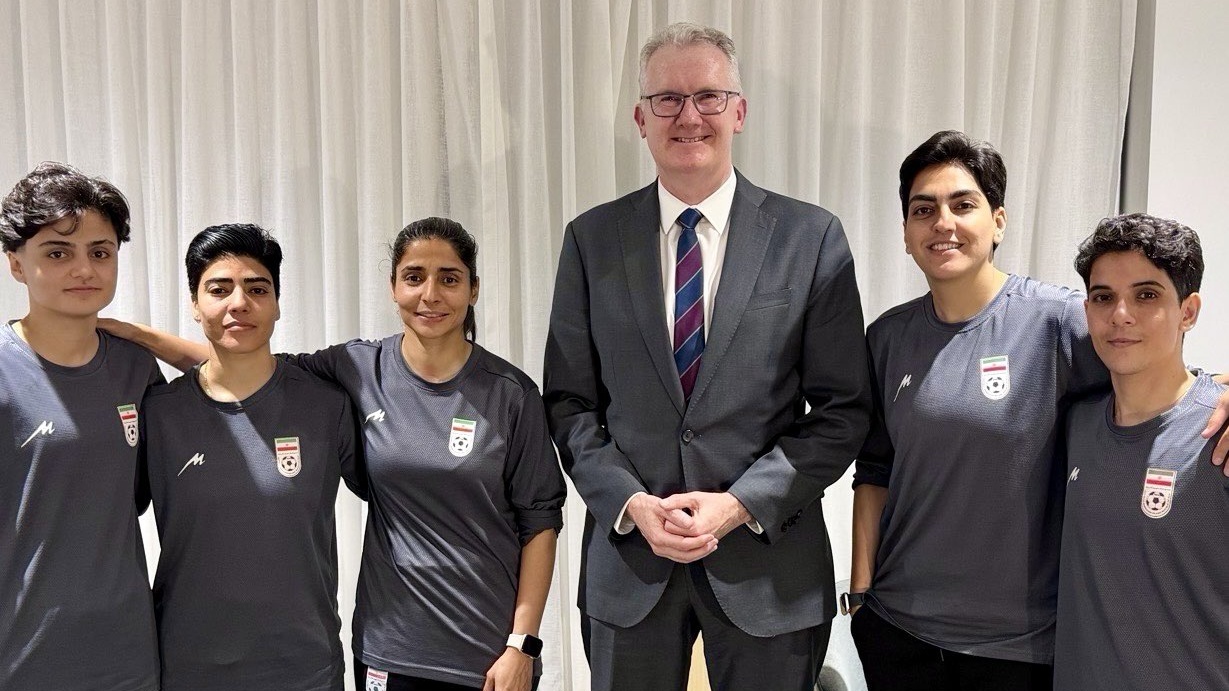
Australia has granted asylum to five members of Iran’s women’s national soccer team after they requested protection while in the country for the Women’s Asian Cup, according to reports from NBC News, The Associated Press, and ABC News. The players had traveled to Australia for the tournament before conflict escalated in Iran, leaving them to decide whether to return home or seek safety abroad.
The case quickly became an international story because it blended sports, geopolitics, and human rights. The players had already drawn global attention after refusing to sing Iran’s national anthem before a match, a gesture widely interpreted as an act of dissent. Iranian state media reportedly condemned the move, while pressure grew in Australia for the government to intervene.
Australia’s asylum decision
Australian Home Affairs Minister Tony Burke said the women were moved to a secure location before their humanitarian visas were approved. Burke also said the rest of the 26-member squad had been offered the chance to remain in Australia if they chose. According to NBC News, the five players wanted it known that they do not consider themselves political activists, underscoring how athletes can become entangled in major world events even when their primary role is competition.
Iran’s exiled crown prince Reza Pahlavi publicly identified the five women as Fatemeh Pasandideh, Zahra Ghanbari, Zahra Sarbali, Atefeh Ramazanzadeh and Mona Hamoudi, according to reporting cited by Straight Arrow News. The status of the remaining team members remains unclear.
Why this sports story matters globally
While the immediate event centers on a national soccer team, the broader significance is international. This is not simply a tournament update; it is a reminder that athletes often become symbols of national identity, protest, and state pressure. In this case, a women’s team found itself at the intersection of war, migration policy, and global media attention.
The episode also comes as international sports bodies face increasing pressure to respond to political crises affecting athletes. FIFA and regional governing organizations have repeatedly been pulled into debates over player safety, national representation, and political expression. Iran’s reported complaint about outside “political interference in football,” noted by AP, reflects the growing tension between the idea that sports should remain separate from politics and the reality that they rarely do.
Latest world context: conflict, displacement, and asylum pressure
The players’ case also fits into a larger global pattern in which conflict is pushing more people to seek refuge beyond their home countries. The U.N. refugee agency has repeatedly warned that wars and political instability are straining asylum systems worldwide. Cases involving high-profile public figures such as athletes tend to attract outsized attention, but they also mirror the choices facing many less visible civilians caught in conflict.
Australia’s move may add to debate over how democracies should handle emergency humanitarian claims made by foreign nationals who are already on their soil. Governments often balance diplomatic considerations with security reviews and domestic politics. In this situation, Canberra appears to have concluded that humanitarian protection outweighed those concerns.
Analysis
The most striking part of this story is not only that five athletes were granted asylum, but that a sports competition became the setting for an international protection decision. It shows how global tournaments can unexpectedly become arenas for political rupture. For the players, the choice was intensely personal. For Australia, it was a test of humanitarian policy under global scrutiny. And for the wider world, it is another example of how conflict abroad can quickly reshape events far from the battlefield.
If more members of the Iranian squad decide to stay, the story could evolve from a one-off asylum case into a broader diplomatic issue involving sport, migration, and women’s rights. For now, the decision ensures that at least five players will not be forced to return immediately to a country facing war and deep political tension.
Sources: NBC News; Associated Press; ABC News; UNHCR; Straight Arrow News.