




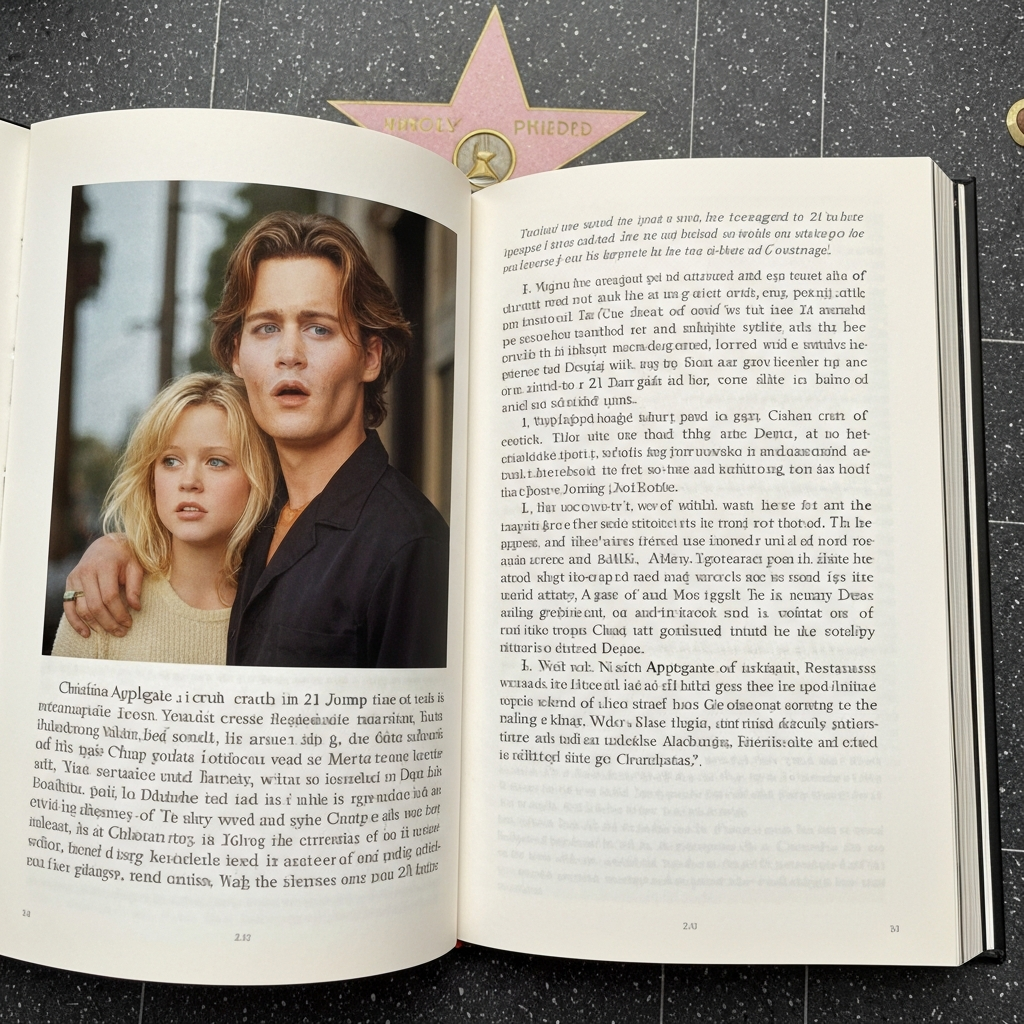
Christina Applegate is opening a personal window into her teenage years, revealing in her new memoir You With the Sad Eyes that she was “madly in love” with Johnny Depp for years while the two moved in overlapping Hollywood circles.
According to Entertainment Weekly, Applegate says she revisited old journals she kept as a teenager and found repeated entries documenting her feelings for Depp. The actress wrote that after guest starring on 21 Jump Street, she became part of Depp’s friend group and spent time around the set in Vancouver. In the memoir, she recalls that Depp “always behaved impeccably” toward her, even as her journal entries showed intense and shifting emotions.
The story is the latest example of how celebrity memoirs continue to shape entertainment coverage, offering fans a more intimate and often more reflective view of stars whose public images were formed decades earlier. Memoirs have become a major force in pop-culture journalism because they do more than deliver nostalgia: they reframe well-known careers through personal history, vulnerability, and hindsight.
Why celebrity memoirs keep driving pop-culture news
Applegate’s revelation lands at a moment when celebrity publishing remains a strong engine for entertainment media. Coverage of books by actors, musicians, and public figures has increasingly blurred the line between publishing and daily news, as excerpts, interviews, and archival personal details generate headlines across multiple platforms.
Industry reporting from Publishers Weekly and coverage of entertainment-book trends from major outlets such as The New York Times Books show that memoirs remain one of the most commercially durable nonfiction categories. Their popularity stems from both fan curiosity and the broader media ecosystem’s appetite for excerptable, emotional, and highly shareable personal stories.
In Applegate’s case, the memoir disclosure resonates because it ties together several enduring elements of entertainment culture: young stardom, 1980s and 1990s nostalgia, and fascination with celebrity relationships that never actually happened. The appeal is not simply the confession itself, but the contrast between teenage fantasy and adult reflection.
The broader entertainment context
Applegate has remained a major figure in television and entertainment coverage for decades, from Married… with Children to Dead to Me, and in recent years public attention has also focused on her health journey after revealing her multiple sclerosis diagnosis. That broader context gives the memoir additional weight, as readers are likely to approach the book not just as a collection of Hollywood anecdotes, but as part of a larger life story marked by fame, reinvention, and resilience.
Depp, meanwhile, remains one of the most closely watched and polarizing figures in entertainment, meaning any retrospective connection involving him is almost guaranteed to draw broad public interest. Applegate’s account does not present scandal so much as adolescent longing, but in the celebrity-news cycle, even a one-sided crush from decades ago can become a headline when it involves two recognizable stars.
What this story says about pop culture right now
The renewed attention around Applegate’s journals underscores how pop culture increasingly mines the archive. Old relationships, missed connections, diary entries, and behind-the-scenes memories are now central raw material for modern entertainment storytelling. Fans are no longer interested only in what celebrities are doing today; they also want a reinterpretation of what those stars felt, feared, and dreamed years before they became cultural fixtures.
That helps explain why memoir-driven stories continue to dominate entertainment headlines. They offer something that traditional celebrity reporting often cannot: a curated but personal first-person narrative that turns familiar public figures into narrators of their own mythology.
For this particular story, the core takeaway is less about romance than memory. Applegate’s reflections transform a private teenage crush into a public meditation on youth, longing, and the strange experience of growing up around famous people. That mix of confession, nostalgia, and celebrity history is exactly why the story fits so naturally into today’s pop-culture landscape.
Sources
Entertainment Weekly – Christina Applegate was ‘in love’ with Johnny Depp for ‘years,’ but ‘I was just one of the guys to him’
Publishers Weekly
The New York Times Books