



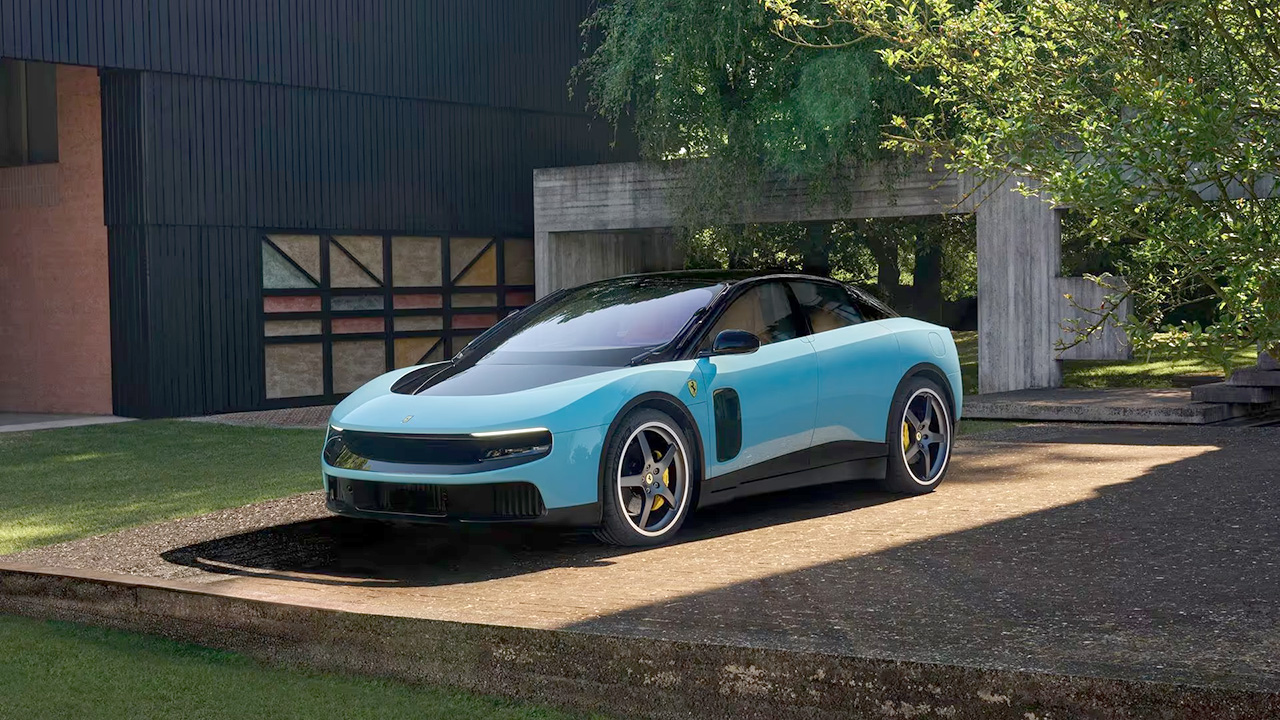
Ferrari has announced its first fully electric production car, the Luce, a four‑door, five‑seat model that the company says reimagines Ferrari architecture for an electric powertrain. Early coverage reports a starting price of about €550,000 in Italy (roughly $640,000), positioning the Luce squarely in the ultra‑luxury segment rather than the mainstream EV market.
Key specifications and company statements
According to Ferrari’s announcement and initial reporting, the Luce is capable of accelerating from 0–100 km/h (≈62 mph) in 2.5 seconds and 0–200 km/h (≈124 mph) in 6.8 seconds. Ferrari places the driving range at “in excess of 530 km” (~329 miles) on its test cycle. The company emphasizes that the electric architecture enabled a radically different interior layout, allowing a four‑door configuration with five seats — the first five‑seat Ferrari in the brand’s history.
Ferrari President John Elkann framed the car as the start of a new chapter for the marque, saying the Luce both extends Ferrari’s sporting tradition and points to its future direction. Initial press coverage also highlighted the steep starting price reported for Italy by The Wall Street Journal and the broader media reaction to Ferrari’s strategy.
What the Luce signals for Ferrari and the luxury EV market
Ferrari entering the battery‑electric segment with a multi‑seat, four‑door model is significant for three reasons:
- Brand evolution: Ferrari has long been associated with two‑seat, driver‑focused sports cars. The Luce shows Ferrari is willing to reinterpret its DNA to deliver electric performance and practical luxury for owners who want more everyday usability.
- Product positioning: At a reported €550k starting price, Ferrari is not competing on volume but on exclusivity and margin. This differentiates the Luce from high‑volume EVs (Tesla, Hyundai, etc.) and places it alongside other ultra‑luxury electrified offerings from established premium houses.
- Technology and architecture: Ferrari’s claims about range and acceleration suggest a high‑capacity battery and performance‑oriented electric motors. If realized in real‑world driving, the combination of range and performance would make the Luce competitive with other high‑end EV grand tourers.
Market context and competitive landscape
The Luce arrives as luxury automakers increasingly electrify their lineups. Competing marques — from Porsche to Mercedes‑Benz, and newer offerings from ultra‑luxury makers — are all bringing battery EVs that target premium buyers. Ferrari’s advantage is brand cachet and a long history in high‑performance engineering, which it will leverage to justify premium pricing and desirability.
That said, the Luce’s commercial success depends on timing, production volume, and how buyers respond to an electric Ferrari that emphasizes practicality over a pure two‑seat sports car experience. The ultra‑wealthy buyer pool is limited but profitable; Ferrari’s strategy appears to be maintaining scarcity to preserve brand value rather than pursuing broader adoption.
Implications for EV adoption and regulations
Ferrari’s move underscores the stratified nature of EV adoption: luxury brands can absorb higher battery costs and translate them into exclusivity, while mainstream manufacturers pursue cost reductions and volume production. From a regulatory perspective, high‑end EVs help manufacturers meet electrification targets and emissions rules, but volume and total emissions impacts largely depend on adoption across the mass market.
Takeaway
The Luce is a statement product: it demonstrates Ferrari’s technological transition to battery propulsion while preserving performance and exclusivity. Its high price and limited target audience mean the model will be symbolic of Ferrari’s EV future more than a mass‑market game changer. For industry watchers, the Luce will be valuable as a benchmark of how a storied performance brand translates its values into an electric era.
Sources:
- Ferrari — official press materials and announcement: https://www.ferrari.com/
- The Wall Street Journal report on pricing and details: https://www.wsj.com/
- Fox News Digital coverage summarizing the announcement: https://www.foxnews.com/
- Context on luxury EV trends and competitors: general industry coverage at https://www.reuters.com/ and https://www.bloomberg.com/