




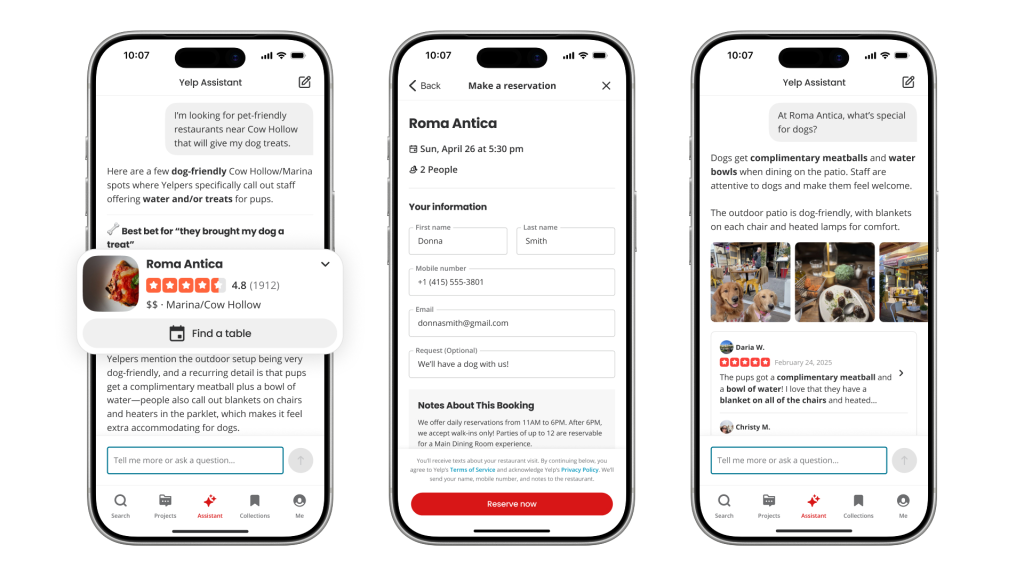
Yelp’s latest product update points to a broader shift in consumer technology: apps are racing to become full-service AI assistants instead of simple search tools. In its newest rollout, Yelp says users can now ask follow-up questions about a restaurant or local business and then complete actions like booking a table, joining a waitlist, or placing an order within the same conversation.
Why This Matters
The update is significant because it moves Yelp beyond discovery and deeper into transaction-driven AI. Rather than forcing users to search, compare, leave the app, and complete a booking elsewhere, Yelp is trying to keep the full customer journey inside a single chat flow. That puts it more directly into competition with other AI-powered consumer platforms, including search engines, delivery services, and reservation tools.
According to TechCrunch’s report, Yelp’s updated AI assistant can answer questions and help users book a restaurant or service in one conversation. Yelp says this experience is designed to reduce friction for people who want quick answers and immediate action, especially on mobile.
The Bigger Trend in Tech
Yelp’s move fits into a much larger wave of AI product development across the tech sector. Over the past year, major platforms have been pushing conversational interfaces that do more than generate text. The new focus is on “agentic” AI systems that can interpret a request, ask clarifying questions, and complete tasks.
That trend has been visible across the industry. Google has been integrating AI more deeply into search and productivity tools, while OpenAI has continued expanding ChatGPT’s utility for browsing, recommendations, and task completion. Meanwhile, companies in food delivery, travel, retail, and local commerce are trying to build assistants that not only inform users but convert intent into purchases.
For Yelp, this strategy makes practical sense. The company already sits on a large database of reviews, business listings, photos, menus, and service information. Adding an AI layer on top of that data could make Yelp more useful at the exact moment when a user is deciding where to eat or which service provider to hire.
What Yelp Is Trying to Solve
Local search can be surprisingly messy. A user might want a pet-friendly brunch spot with outdoor seating, strong vegetarian options, and reservations available before 7 p.m. Traditionally, that could require scanning multiple listings, checking third-party booking tools, and opening several apps. A conversational assistant can simplify that process by turning a complex search into a single back-and-forth exchange.
That convenience is also where the business opportunity lies. If Yelp can shorten the path from question to transaction, it may increase user engagement while improving monetization through reservations, sponsored visibility, ordering partnerships, and local service leads.
The Competitive Landscape
The local commerce space is getting more crowded as AI becomes a core feature rather than an experiment. Yelp faces pressure not only from Google, which remains dominant in local discovery, but also from specialized platforms such as DoorDash, OpenTable, Uber Eats, and a growing number of AI-native assistants.
In that environment, user trust becomes crucial. AI assistants are only as good as the accuracy of their recommendations, the freshness of their business data, and the clarity of their handoff into booking or ordering systems. If the assistant gives outdated hours, incomplete menu details, or mismatched reservation options, users may quickly revert to older search habits.
Key Questions Ahead
Yelp’s announcement also raises bigger questions about the next stage of consumer AI. Will users prefer specialized assistants built around a single domain like restaurants and services, or broader assistants that can plan an entire outing across multiple apps? Can review-based platforms preserve trust while using AI to summarize, rank, and recommend options? And how transparent will these systems be about sponsored placements, partner integrations, or the reasoning behind recommendations?
Those questions matter because AI interfaces are increasingly shaping not just what people find, but what they choose. In local commerce, that influence can directly affect small business visibility and customer spending.
Our Take
Yelp’s updated assistant is less about flashy AI and more about practical utility. That may be exactly the right approach. Consumers often care less about the underlying model and more about whether the tool saves time and reduces hassle. If Yelp can deliver reliable answers and seamless transactions, it has a real chance to strengthen its role in local discovery.
Still, success will depend on execution. AI in local search works best when it is accurate, fast, transparent, and closely tied to real inventory, reservations, and business information. If Yelp gets those fundamentals right, this update could be an important example of how AI becomes embedded in everyday consumer behavior—not as a novelty, but as a tool people use to make decisions and get things done.