


Uber and Rivian are teaming up on one of the biggest autonomous vehicle partnerships announced this year, with Uber committing an initial $300 million investment and the broader deal potentially reaching $1.25 billion. Under the agreement, Rivian is expected to provide as many as 50,000 autonomous-ready R2 SUVs, giving Uber a major new path to expand its robotaxi ambitions.
Why this falls under Tech
This story is best categorized as Tech because the core development is not simply a transportation or corporate partnership story. At its heart, it is about autonomous driving systems, next-generation vehicle platforms, software-enabled mobility, and the commercialization of robotaxis. The deal sits squarely at the intersection of artificial intelligence, electric vehicles, sensors, autonomy stacks, and platform economics.
Uber and Rivian push deeper into autonomous mobility
The headline itself signals a broader shift in the technology industry: major platforms are no longer treating autonomous vehicles as distant experiments. They are moving toward scaled deployment strategies built around partnerships. Uber, which previously retreated from developing its own self-driving division in-house, has increasingly leaned on alliances to stay central in the autonomous transportation future. Rivian, meanwhile, gains a potentially transformative commercial channel for its R2 platform.
According to TechCrunch, Uber is beginning the partnership with a $300 million investment, while Rivian could supply up to 50,000 autonomous R2 SUVs over time. That scale matters. In robotaxi economics, fleet volume can determine whether a service remains a pilot project or becomes a durable business.
The bigger autonomous vehicle race in 2026
This announcement lands amid a much broader race across the autonomous vehicle sector. Companies have spent years trying to prove that self-driving technology can move from expensive demos into viable, repeatable transportation services. Progress has been uneven. Some companies have expanded commercial service zones, while others have slowed deployments, restructured programs, or shifted strategy toward partnerships and narrower use cases.
Recent reporting from Reuters has continued to show how the autonomous vehicle market is evolving around a few practical questions: who owns the customer, who operates the fleet, who supplies the hardware, and who carries the regulatory and safety burden. Uber’s model increasingly appears to be platform-first. Rather than trying to own every piece of the self-driving stack, it can connect riders, fleet operations, and autonomous partners through its existing marketplace.
That strategy mirrors a wider trend in tech. Platform companies are seeking ways to remain indispensable even when they do not build every layer of the product themselves. In this case, Uber brings demand, logistics, payments, and app distribution. Rivian brings the vehicle architecture. The missing and most critical layer, autonomous driving capability, will define how fast this partnership can move from announcement to real-world service.
Why Rivian’s role is significant
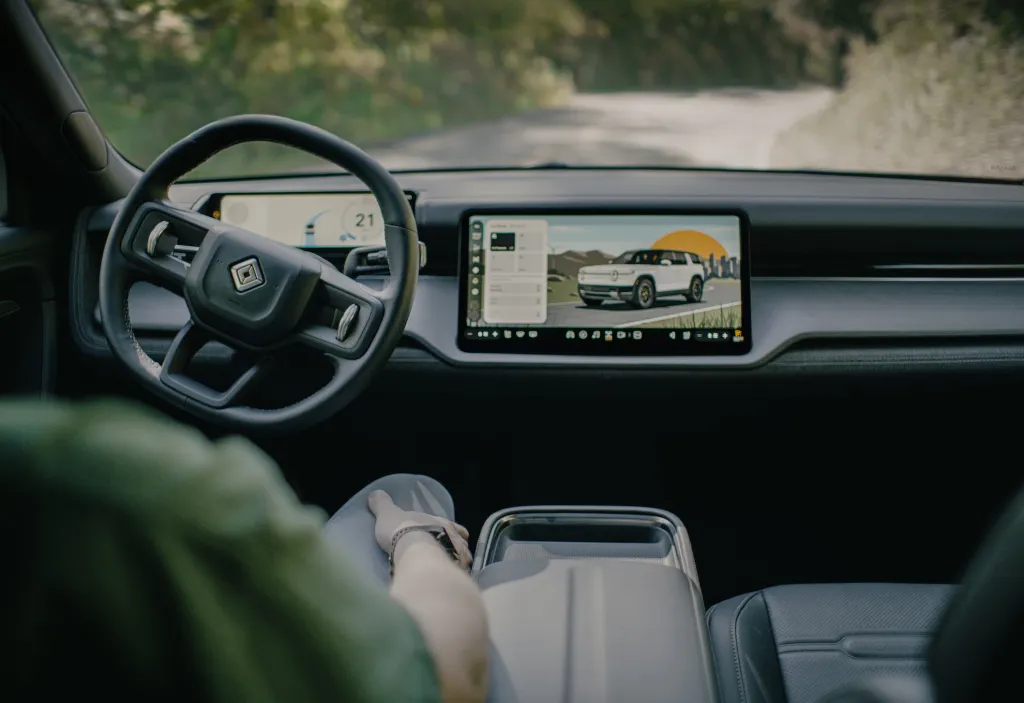
Rivian is best known for its electric trucks, SUVs, and commercial van ambitions, but this deal suggests the company also sees long-term value in becoming a foundational hardware supplier for future mobility services. The Rivian R2 has already attracted attention as a more mainstream and scalable EV platform than some of the company’s earlier premium offerings. If adapted successfully for autonomous deployment, it could become one of the more visible purpose-adjacent robotaxi vehicles in the U.S. market.
That matters because robotaxi services need more than software. They need vehicles designed for uptime, repairability, sensor integration, passenger comfort, and cost discipline. A flashy demo car is not enough. The business only works if the vehicle can survive heavy daily use and remain economical to maintain.
How this compares with the rest of the industry
The autonomous vehicle sector remains crowded, but not all players are pursuing the same path. Waymo has continued to expand commercial robotaxi operations in select markets, positioning itself as one of the clearest frontrunners in real passenger deployment. Cruise, after facing operational and regulatory setbacks, has served as a reminder that scaling autonomy is not just a technological problem but also a public trust and governance challenge. Tesla continues to promote its own autonomy ambitions, though its strategy differs significantly in both technical philosophy and deployment model.
Against that backdrop, Uber’s partnership approach may be the more realistic route. It lowers capital intensity compared with building a full-stack autonomous unit from scratch, while preserving Uber’s strategic relevance if robotaxis become a larger share of urban transportation.
The real challenge: safety, regulation, and public confidence
No robotaxi announcement can be understood purely as a technology or business story. The hardest part of autonomous deployment is often everything around the technology: regulation, insurance, municipal cooperation, liability, fleet monitoring, emergency response procedures, and public acceptance.
Coverage from the National Highway Traffic Safety Administration and ongoing local regulatory debates have made clear that autonomous vehicle companies operate under intense scrutiny. Every incident carries outsized consequences, not only for one company but for the category as a whole. If Uber and Rivian want this deal to become a meaningful commercial success, they will need to show that autonomy can be deployed safely, transparently, and consistently at scale.
What this means for Uber’s future
For Uber, this is about protecting its place in the next era of ride-hailing. Human drivers remain essential to its current business, but the company knows autonomy could eventually reshape cost structures and competitive dynamics across the sector. If robotaxis become viable in more cities, the platform controlling demand and rider relationships may hold enormous leverage.
That is why this deal is strategically important even before the first autonomous Rivian R2 carries a passenger. It shows Uber does not intend to sit on the sidelines while other companies define the robotaxi market. Instead, it is using capital and partnerships to secure optionality in a technology transition that could take years to unfold but may ultimately redefine urban mobility.
Bottom line
The Uber-Rivian robotaxi agreement is one of the clearest signs yet that autonomous transportation is moving back into an expansion phase, but this time with more disciplined expectations. The era of hype-only promises has given way to a tougher reality: partnerships, deployment logistics, regulatory negotiation, and sustainable economics matter just as much as breakthrough software.
If the companies execute well, this deal could become a major benchmark for how tech platforms and EV manufacturers collaborate in the autonomous age. If they do not, it will join the long list of ambitious mobility bets that looked compelling on paper but struggled in the real world.
Sources:
TechCrunch – Uber taps Rivian to build robotaxis in deal worth up to $1.25B
Reuters – Latest coverage on autonomous vehicles and mobility
Rivian official website
Waymo official website
Cruise official website
NHTSA official website
Tesla AI and autonomy