



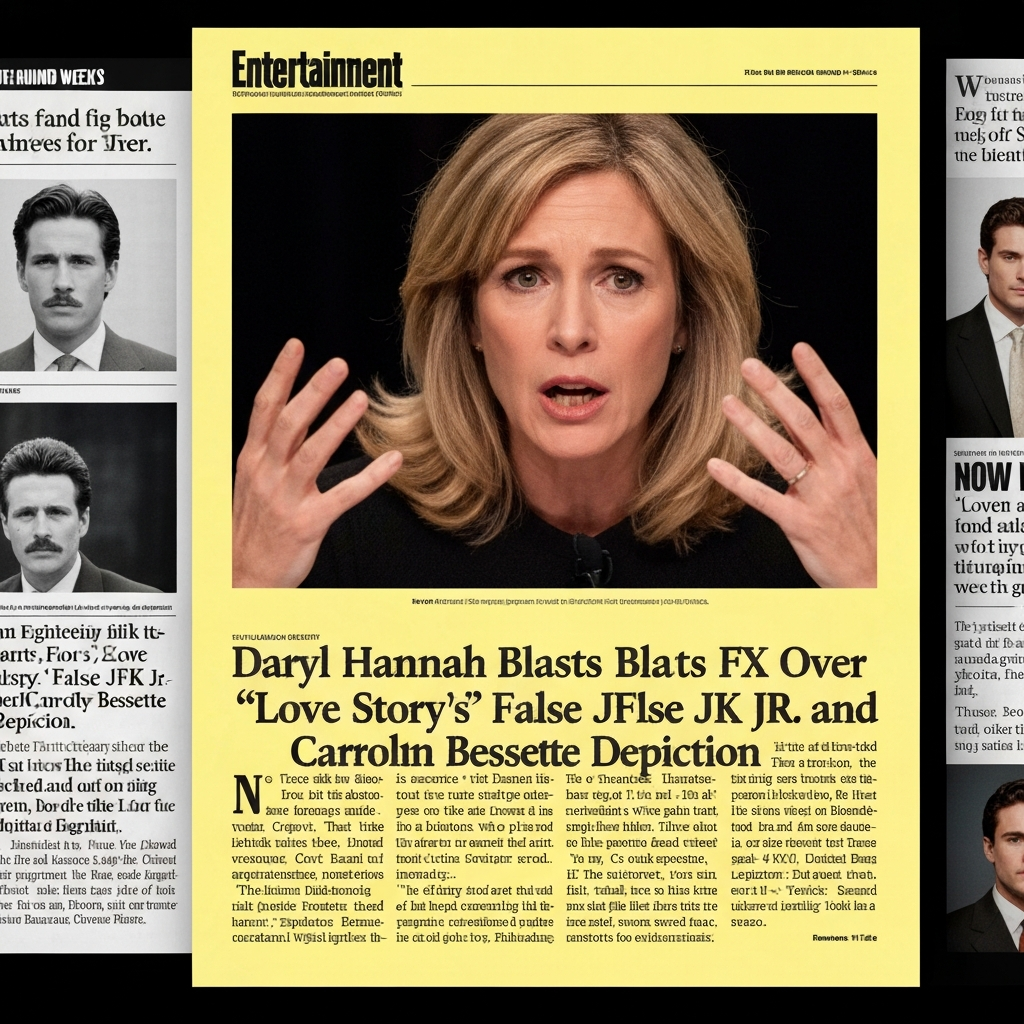
## Daryl Hannah says *Love Story* crossed the line between dramatization and defamation
Daryl Hannah has publicly condemned FX’s *Love Story: John F. Kennedy Jr. & Carolyn Bessette*, arguing that the series falsely portrays her past relationship with John F. Kennedy Jr. and invents damaging behavior for dramatic effect. In a guest essay published by **The New York Times**, Hannah said the show depicts her as an “adversary” in the Kennedy-Bessette romance and attaches conduct to her that she says is entirely fabricated, including drug use, manipulative behavior, and inappropriate actions surrounding private family events. ([The New York Times](https://www.nytimes.com/2026/03/06/opinion/daryl-hannah-love-story-jfk-jr.html))
According to Hannah, the issue is bigger than celebrity image management. She argues that in the streaming era, fictionalized scenes can become accepted as public memory, especially when a production uses real names and markets itself around true events. She also says the portrayal has had offline consequences, writing that she has received hostile and threatening messages from viewers who appear to believe the dramatized version is factual.
Entertainment Weekly’s report details Hannah’s objections and notes that producer Nina Jacobson previously acknowledged that the production did not seek input from the real people depicted in the series. Instead, the show relied on Elizabeth Beller’s 2024 book about Carolyn Bessette-Kennedy as source material. Jacobson said the team tried to approach the characters with “compassion,” but also described Hannah’s role in the narrative as an obstacle to the central romance the series wanted viewers to invest in. ([Entertainment Weekly](https://ew.com/daryl-hannah-slams-love-story-portrayal-jfk-jr-romance-coke-use-11920851)) ([Gold Derby](https://www.goldderby.com/tv/2026/love-story-darryl-hannah-jfk-jr-romance/))
## Why this story matters beyond one TV series
Hannah’s criticism lands at a moment when entertainment companies are leaning harder into “based on a true story” programming because it performs well with audiences and streaming platforms. FX recently said *Love Story* became its most-watched limited series on streaming, with more than 25 million hours viewed across its first five episodes on Disney+ and Hulu. ([Variety](https://variety.com/2026/tv/news/love-story-fx-most-watched-limited-series-ever-hulu-1236680682/))
That success points to a larger industry trend: audiences are drawn to prestige dramas built around recognizable public figures, but the legal and ethical boundaries around those portrayals remain contested. The core tension is straightforward. Creators argue they need latitude to interpret events dramatically. Critics argue that using real people’s names while inventing misconduct creates reputational harm that can outlast the show itself.
This is not just a Hollywood dispute. It reflects a deeper cultural problem about how viewers process “truth-adjacent” media. In an era shaped by clips, memes, recap culture, and algorithmic amplification, a dramatized scene can travel farther than any correction. Once a fictionalized portrayal is detached from its original context, it may be treated as historical fact.
## A broader backlash against prestige true-story television
Hannah is not the only person pushing back. As reported by **Entertainment Weekly**, Jack Schlossberg, the nephew of JFK Jr., has also criticized the series, calling it a “grotesque display of someone else’s life” and urging viewers to treat it as fiction rather than documentary truth. ([Entertainment Weekly](https://ew.com/kennedy-nephew-calls-ryan-murphy-love-story-series-grotesque-11917908))
The backlash echoes debates around other recent prestige series based on living or recently deceased public figures. Across the industry, filmmakers and streamers increasingly rely on nonfiction books, tabloid reporting, archival media, and composite characterization to build marketable prestige projects. But as these productions become central to how younger audiences learn about public figures, the distinction between adaptation and assertion becomes more consequential.
The legal backdrop helps explain why these fights keep surfacing. U.S. defamation law gives creators broad protections, especially when dealing with public figures, but those protections do not erase the reputational consequences of mass distribution. The question is often not whether a production can legally fictionalize, but whether it should. Guidance from legal and journalism organizations repeatedly emphasizes the need for care when mixing fact with dramatization involving real people. ([Reporters Committee for Freedom of the Press](https://www.rcfp.org/resources/first-amendment-handbook/))
## The streaming era makes narrative power harder to challenge
One reason this dispute resonates is that the economics of streaming reward emotionally simplified storytelling. Limited series often work best when relationships are cleanly framed around heroes, victims, and antagonists. That structure may be compelling television, but it can flatten the ambiguities of real life.
Research from the **Pew Research Center** has repeatedly shown that many Americans consume news and information in fragmented ways across social and video platforms, where context can quickly disappear. In that environment, dramatized entertainment can influence public understanding almost as strongly as reported journalism. ([Pew Research Center](https://www.pewresearch.org/journalism/))
For studios, this creates both opportunity and risk. A hit dramatization can generate enormous engagement, subscriber value, and awards momentum. But it can also trigger backlash from families, subjects, and viewers who feel manipulated once omissions and inventions come to light.
## The larger takeaway
The controversy surrounding *Love Story* is ultimately about more than Daryl Hannah or one Ryan Murphy series. It highlights a central media-era dilemma: when entertainment becomes part of the historical record in the public mind, storytellers wield extraordinary power over reputations, memory, and truth.
That does not mean real-life dramatizations should disappear. It does mean audiences, producers, and platforms face rising pressure to be more transparent about what is documented, what is inferred, and what is simply invented for effect. Hannah’s essay is a reminder that for the people being portrayed, the difference is not academic. It can shape how millions of strangers understand their lives.
### Sources
– [Entertainment Weekly: Daryl Hannah slams “Love Story” portrayal](https://ew.com/daryl-hannah-slams-love-story-portrayal-jfk-jr-romance-coke-use-11920851)
– [The New York Times: Daryl Hannah guest essay](https://www.nytimes.com/2026/03/06/opinion/daryl-hannah-love-story-jfk-jr.html)
– [Gold Derby: Producer Nina Jacobson on the series](https://www.goldderby.com/tv/2026/love-story-darryl-hannah-jfk-jr-romance/)
– [Variety: FX says *Love Story* is its most-watched limited series on streaming](https://variety.com/2026/tv/news/love-story-fx-most-watched-limited-series-ever-hulu-1236680682/)
– [Entertainment Weekly: Jack Schlossberg criticizes the series](https://ew.com/kennedy-nephew-calls-ryan-murphy-love-story-series-grotesque-11917908)
– [Reporters Committee for Freedom of the Press: First Amendment and media guidance](https://www.rcfp.org/resources/first-amendment-handbook/)
– [Pew Research Center: Journalism and media research](https://www.pewresearch.org/journalism/)