


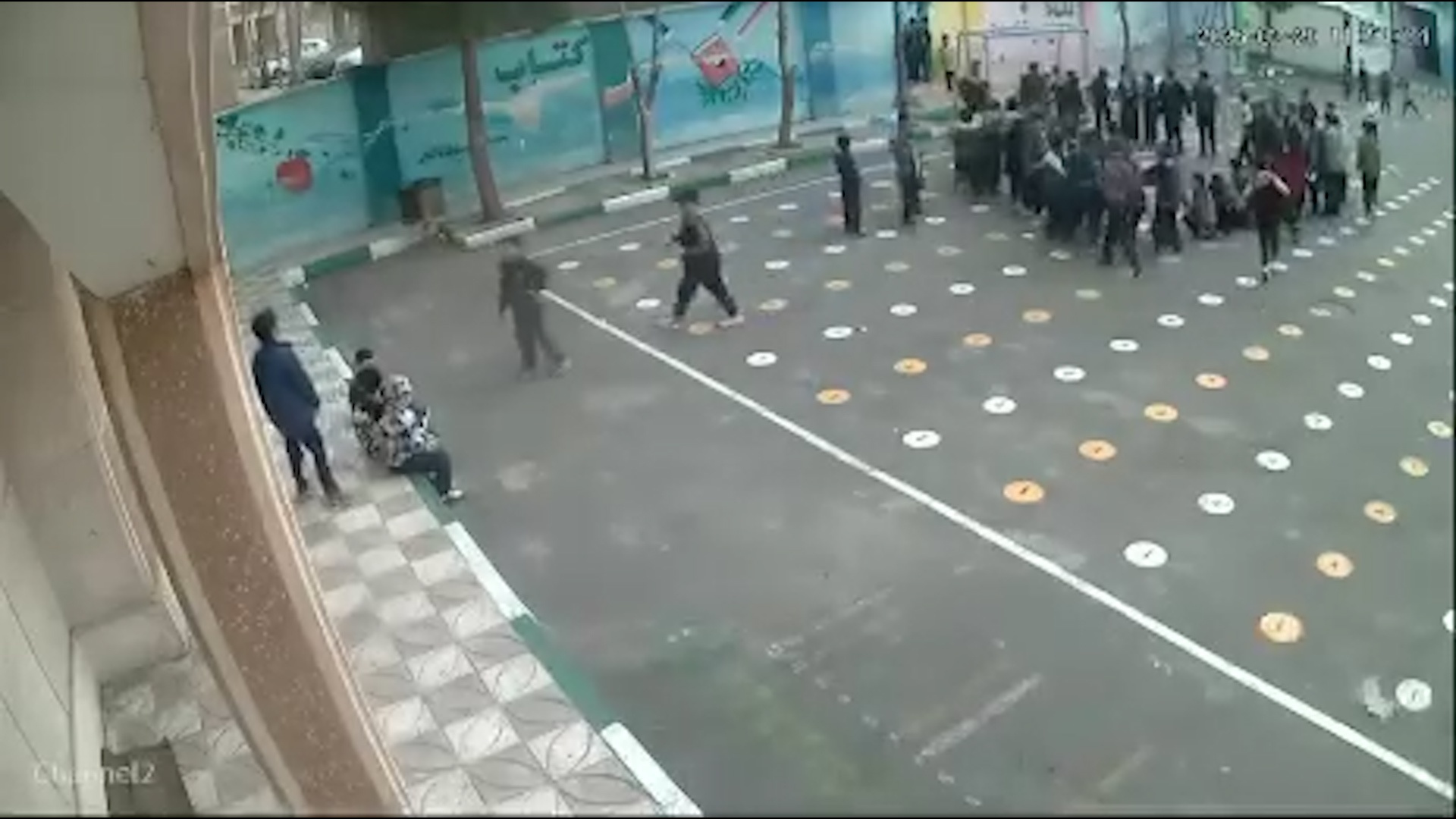
A newly surfaced video verified by The New York Times appears to show an explosion erupting near a boys’ elementary school in Abyek, western Iran, during the opening day of U.S.-Israeli strikes on the country. The footage, captured by security cameras at Imam Reza Elementary School, shows dozens of children on the playground moments before a nearby blast shatters windows and sends debris toward the school.
Blast near school raises new scrutiny
The Times reported that satellite imagery and geolocation analysis matched the video to a communications tower on a hillside less than 400 feet from the playground. Before-and-after satellite images reviewed by the paper show the tower was destroyed in the explosion. Iranian state media identified one child, Mahyar Zanganeh, as having died from debris injuries.
The incident is drawing renewed international attention because it appears to be the second known blast near a school on the first day of the conflict. Straight Arrow News also reported on a separate strike near a girls’ school in Minab, where Iranian officials said 175 people were killed, most of them children. The New York Times separately reported that video from that incident showed a Tomahawk cruise missile striking a nearby Islamic Revolutionary Guard Corps naval base, though neither the United States nor Israel has publicly accepted responsibility for the school-adjacent blast.
Why this matters in the wider conflict
The emergence of visual evidence from Abyek adds to mounting questions over how military targets are being selected in densely populated civilian areas. Under international humanitarian law, parties to a conflict are required to distinguish between military and civilian objects and to take precautions to minimize civilian harm. Even when the apparent target is military or communications infrastructure, strikes near schools are likely to trigger close scrutiny from rights monitors, diplomats and investigators.
President Donald Trump said this week that at least one of the reported incidents was still under investigation, according to comments published by Straight Arrow News. So far, there has been no formal public accounting from the Pentagon or Israeli officials about the Abyek explosion.
Latest world reaction and diplomatic context
The broader conflict is unfolding amid intensified diplomatic pressure and growing concern from international observers. Coverage from Reuters World has highlighted continued attention on regional escalation risks, while the United Nations has repeatedly warned in past conflict zones that attacks affecting schools and children can carry major humanitarian and legal consequences. Reporting from The Associated Press and BBC World has likewise shown how battlefield incidents captured on video are increasingly becoming central evidence in public accountability debates.
The Abyek footage underscores a larger reality of modern war: open-source verification, satellite imagery and social-media video now shape the first draft of accountability long before official investigations conclude. For governments involved in fast-moving military operations, that means public skepticism can build quickly when civilian sites appear to have been endangered.
What comes next
The key unanswered questions are whether the communications tower beside the school was the intended target, who carried out the strike and whether adequate precautions were taken given the tower’s proximity to children. Independent verification by major news organizations has increased pressure for clearer answers.
If more evidence emerges, the Abyek incident could become an important test case in how wartime claims are assessed in real time — and in whether governments provide transparent explanations when military action appears to place schools directly in harm’s way.
Sources: Straight Arrow News; The New York Times; The New York Times (Minab report); Reuters World; AP World News; BBC World; United Nations.