




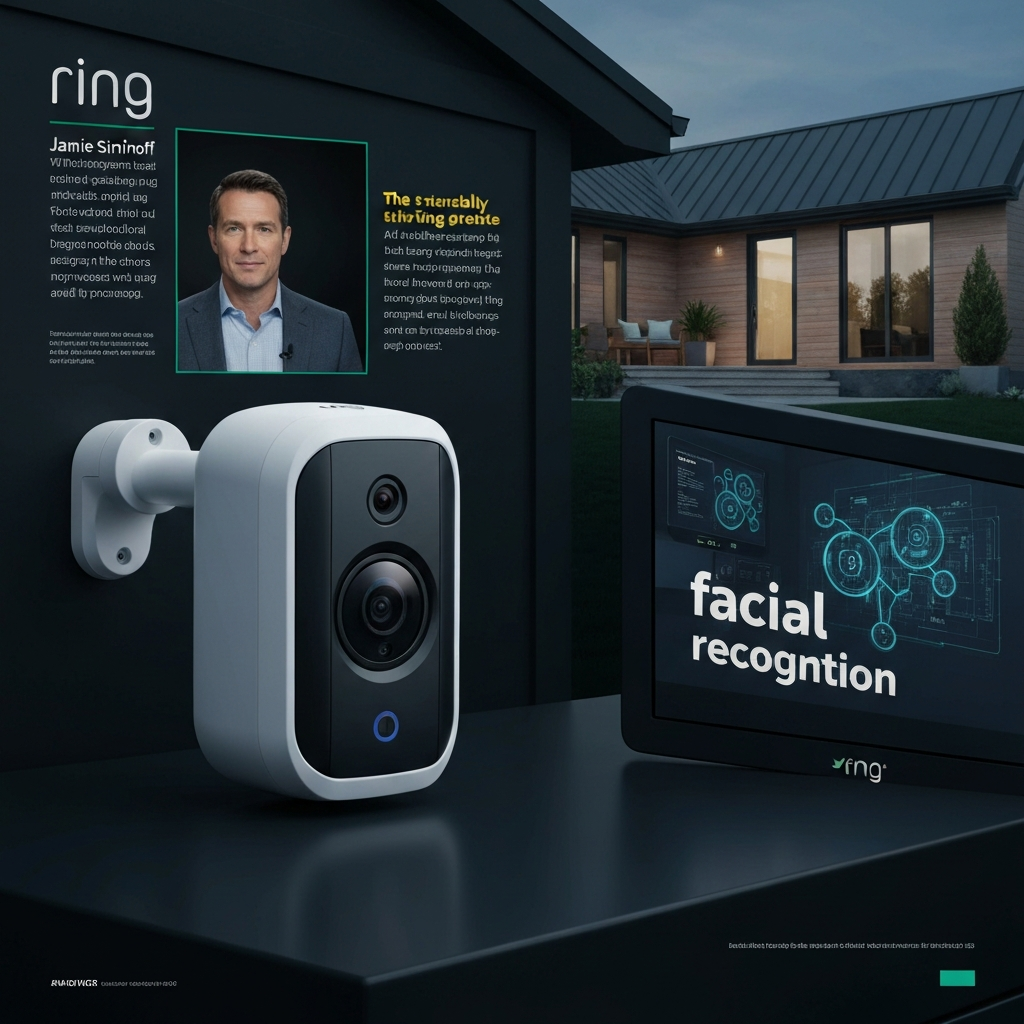
Ring founder Jamie Siminoff is again attempting to reassure the public that the company is taking privacy seriously, but the latest discussion around Ring shows how unresolved concerns over surveillance technology continue to follow the smart-home giant.
## Why this story matters
The latest flashpoint centers on facial recognition and how far consumer security companies should go in identifying people captured on home surveillance cameras. Ring, long promoted as a neighborhood safety tool, remains under scrutiny from privacy advocates, lawmakers, and digital rights experts who argue that expanded identification features could push consumer devices deeper into mass surveillance territory.
According to [TechCrunch](https://techcrunch.com/2026/03/08/rings-jamie-siminoff-has-been-trying-to-calm-privacy-fears-since-the-super-bowl-but-his-answers-may-not-help/), Siminoff has been trying since the Super Bowl to calm fears around Ring’s privacy posture, but his answers have raised fresh questions rather than fully settling the issue. The most sensitive area is whether facial recognition technology could be incorporated into Ring’s ecosystem in ways that make it easier to identify people moving through neighborhoods.
## The bigger trend in tech
This debate is not unfolding in isolation. Across the technology sector, companies developing AI-powered cameras, biometric systems, and smart-home products are facing a more skeptical public. Concerns generally fall into three areas: consent, data retention, and misuse.
The [Electronic Frontier Foundation](https://www.eff.org/issues/face-recognition) has repeatedly warned that face recognition systems can enable persistent tracking while creating civil liberties risks, especially when deployed at scale. Meanwhile, the [Federal Trade Commission](https://www.ftc.gov/business-guidance/privacy-security) has continued emphasizing that companies handling sensitive consumer data must be transparent about collection, use, and retention practices.
Recent reporting and public policy discussions have also highlighted how AI surveillance tools are moving faster than the rules designed to govern them. The [National Institute of Standards and Technology](https://www.nist.gov/itl/ai-risk-management-framework) has promoted AI risk-management frameworks meant to help organizations evaluate bias, accountability, and privacy impacts before rolling out high-risk systems.
## Why Ring keeps drawing attention
Ring occupies a particularly visible place in this conversation because its products sit at the intersection of consumer convenience, neighborhood watch culture, and law-enforcement interest. Past criticism of Ring has involved its relationships with police departments, the sharing of footage, and questions over whether users and bystanders fully understand how their images and personal data may be used.
Even when a company frames advanced recognition features as tools for safety or convenience, critics argue that the practical result can be broader social monitoring. A smart doorbell that distinguishes family members from strangers may sound benign on paper, but privacy experts note that such functionality can expand into searchable identity systems if guardrails are weak.
The concern is not merely theoretical. The [American Civil Liberties Union](https://www.aclu.org/issues/privacy-technology/surveillance-technologies/face-recognition-technology) has argued that face recognition technology can chill free expression and disproportionately affect marginalized communities. That makes any suggestion of facial recognition in an already widespread home-camera platform especially controversial.
## Latest developments shaping the conversation
The broader tech industry has recently been grappling with a wave of AI governance questions, from biometric regulation to platform accountability. In Europe, the [European Commission’s AI policy framework](https://digital-strategy.ec.europa.eu/en/policies/european-approach-artificial-intelligence) has continued pushing risk-based oversight of high-impact AI applications, including some biometric uses. In the United States, regulators and lawmakers have taken a more fragmented approach, but scrutiny of AI products has clearly increased.
At the same time, large technology platforms are racing to ship more AI-enabled consumer products, putting pressure on companies to innovate before public trust frameworks are fully in place. That tension helps explain why statements meant to reassure audiences can sometimes backfire: users increasingly want specifics, not broad promises.
## Analysis: reassurance is no longer enough
The Ring story illustrates a larger shift in the tech industry. For years, companies could respond to privacy criticism with general commitments to safety, security, and user control. That approach is proving less effective as consumers, researchers, and regulators become more sophisticated in questioning how these systems actually work.
Today, the key questions are much more concrete: Is facial data stored? For how long? Is it processed locally or in the cloud? Can law enforcement access it? Can users opt out completely? Are non-users whose faces are captured given any meaningful protection? Without direct answers, privacy fears tend to deepen rather than fade.
For Ring, the challenge is that trust is now a product feature. In the smart-home market, hardware quality alone is not enough; companies must also show that they can responsibly manage sensitive visual and biometric data. If they cannot, every new feature announcement risks being interpreted through the lens of surveillance rather than safety.
## What comes next
The pressure on Ring and similar companies is likely to intensify as AI makes cameras smarter and more capable of identifying behavior, objects, and people. That will create new commercial opportunities, but it will also sharpen the debate over where household security ends and pervasive monitoring begins.
For now, the latest controversy suggests that privacy concerns surrounding Ring are far from resolved. If the company wants to win over skeptics, it may need to do more than offer reassurance. It may need to provide clear technical disclosures, stronger user protections, and firmer boundaries around how recognition technology can be deployed.
### Sources
– [TechCrunch: Ring’s Jamie Siminoff has been trying to calm privacy fears since the Super Bowl, but his answers may not help](https://techcrunch.com/2026/03/08/rings-jamie-siminoff-has-been-trying-to-calm-privacy-fears-since-the-super-bowl-but-his-answers-may-not-help/)
– [Electronic Frontier Foundation: Face Recognition](https://www.eff.org/issues/face-recognition)
– [Federal Trade Commission: Privacy and Security](https://www.ftc.gov/business-guidance/privacy-security)
– [NIST AI Risk Management Framework](https://www.nist.gov/itl/ai-risk-management-framework)
– [ACLU: Face Recognition Technology](https://www.aclu.org/issues/privacy-technology/surveillance-technologies/face-recognition-technology)
– [European Commission: European approach to artificial intelligence](https://digital-strategy.ec.europa.eu/en/policies/european-approach-artificial-intelligence)