


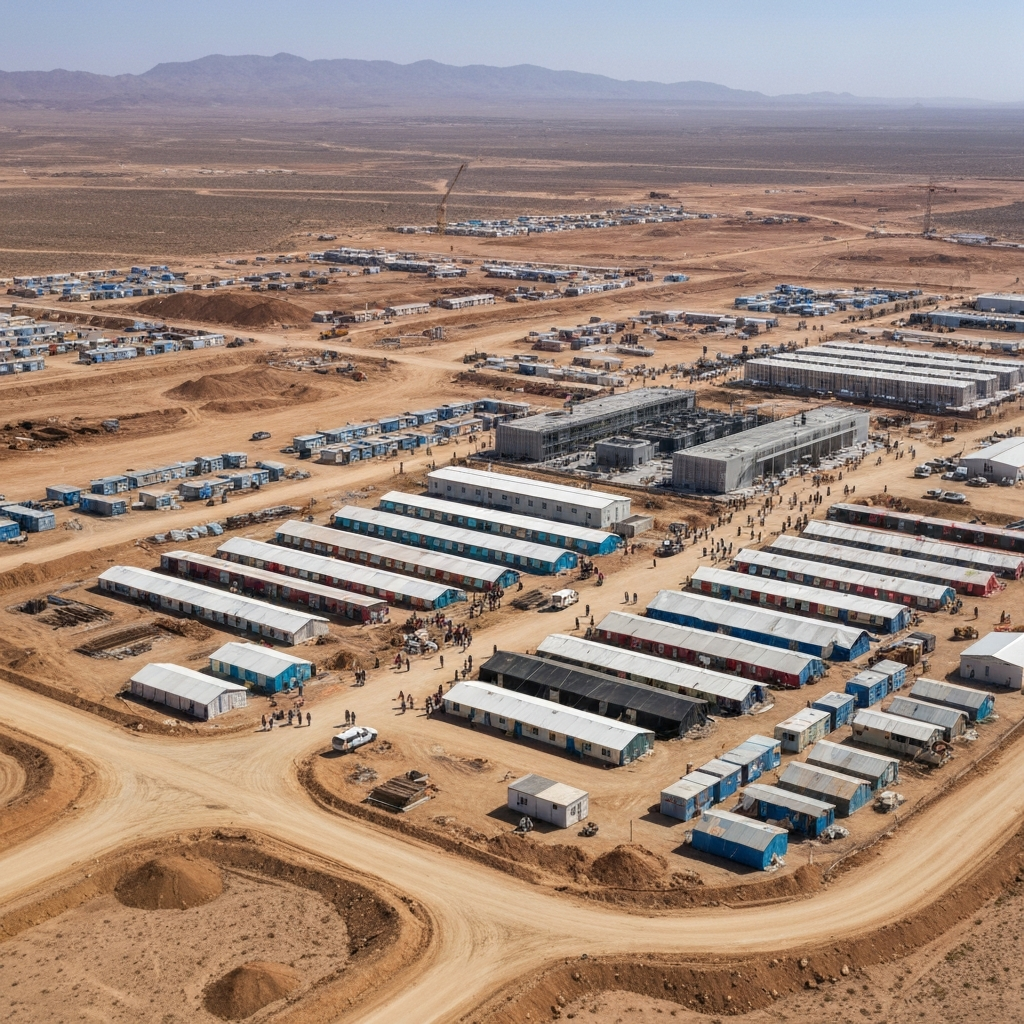
AI infrastructure is creating demand far beyond chips and servers. One of the clearest signs is the growing use of temporary remote housing camps for construction crews building large data center projects in isolated or infrastructure-poor areas.
A recent TechCrunch report highlights how companies tied to workforce lodging see a new opportunity in the AI buildout. As hyperscalers and developers race to expand computing capacity for generative AI, they are confronting a practical bottleneck: where to house thousands of workers needed to construct and support these facilities.
AI demand is now reshaping physical infrastructure
The AI race is often framed around software models and semiconductor supply, but the real-world expansion is increasingly visible in power, land, cooling, and labor. Large data centers require enormous construction efforts, and many projects are being developed in locations chosen for electricity access, tax incentives, or available land rather than proximity to major urban housing.
That mismatch is helping create a market for modular workforce accommodations similar to those long used in oil, gas, and mining regions. In this sense, AI is starting to resemble other capital-intensive industrial booms: it needs not just investment and technology, but logistics, temporary housing, and local infrastructure.
Recent reporting and company announcements support the broader picture of rapid data center expansion. Microsoft has continued emphasizing AI infrastructure investment in its public disclosures, while cloud and chip leaders have described sustained demand for new capacity. Nvidia, for example, has repeatedly pointed to supply-demand pressure across AI computing systems, and major cloud providers have been racing to secure power and construction resources for new sites. These trends suggest the labor and housing strains described in the TechCrunch story are not isolated, but part of a wider buildout cycle.
Why this matters for business
From a business perspective, the story is about more than unusual worker housing. It reflects the emergence of a secondary economy around AI: construction contractors, utilities, cooling specialists, real estate developers, equipment suppliers, and temporary lodging operators are all finding new revenue opportunities as demand for compute expands.
That also raises questions for investors and local communities. If AI data centers generate a wave of temporary workforce migration, municipalities may face pressure on roads, public services, and housing markets. At the same time, the projects can create jobs and tax revenue, particularly in areas that have struggled to attract large-scale industrial investment.
The bigger takeaway is that AI’s economic footprint is widening. What began as a story about models and cloud platforms is increasingly a story about industrial capacity on the ground. The next phase of the AI boom may be defined as much by who can build and power data centers quickly as by who has the best model.
Latest developments shaping the backdrop
Several ongoing trends help explain why support industries are moving aggressively:
- Cloud providers and enterprise customers continue increasing spending on AI workloads, driving demand for new server capacity.
- Utilities in multiple regions are grappling with how to meet the power needs of large data center campuses.
- Developers are looking beyond traditional tech hubs for land and energy availability, often landing in areas with limited housing stock.
- Supply-chain competition for transformers, cooling systems, and electrical equipment is extending development timelines.
Together, those forces are creating opportunities for companies that can solve practical deployment problems quickly—including temporary worker accommodations.
Context and outlook
The use of camp-style housing may sound jarring in the context of AI, an industry typically marketed through sleek consumer products and high-level software claims. But it underscores a basic truth: advanced computing still depends on old-economy inputs. Land must be cleared. Buildings must be assembled. Transmission and cooling must be installed. People must be housed.
As AI investment accelerates, expect more attention on these less glamorous but economically crucial layers of the stack. For businesses serving industrial development, the AI revolution may look less like a chatbot and more like a massive construction cycle.
Sources: