


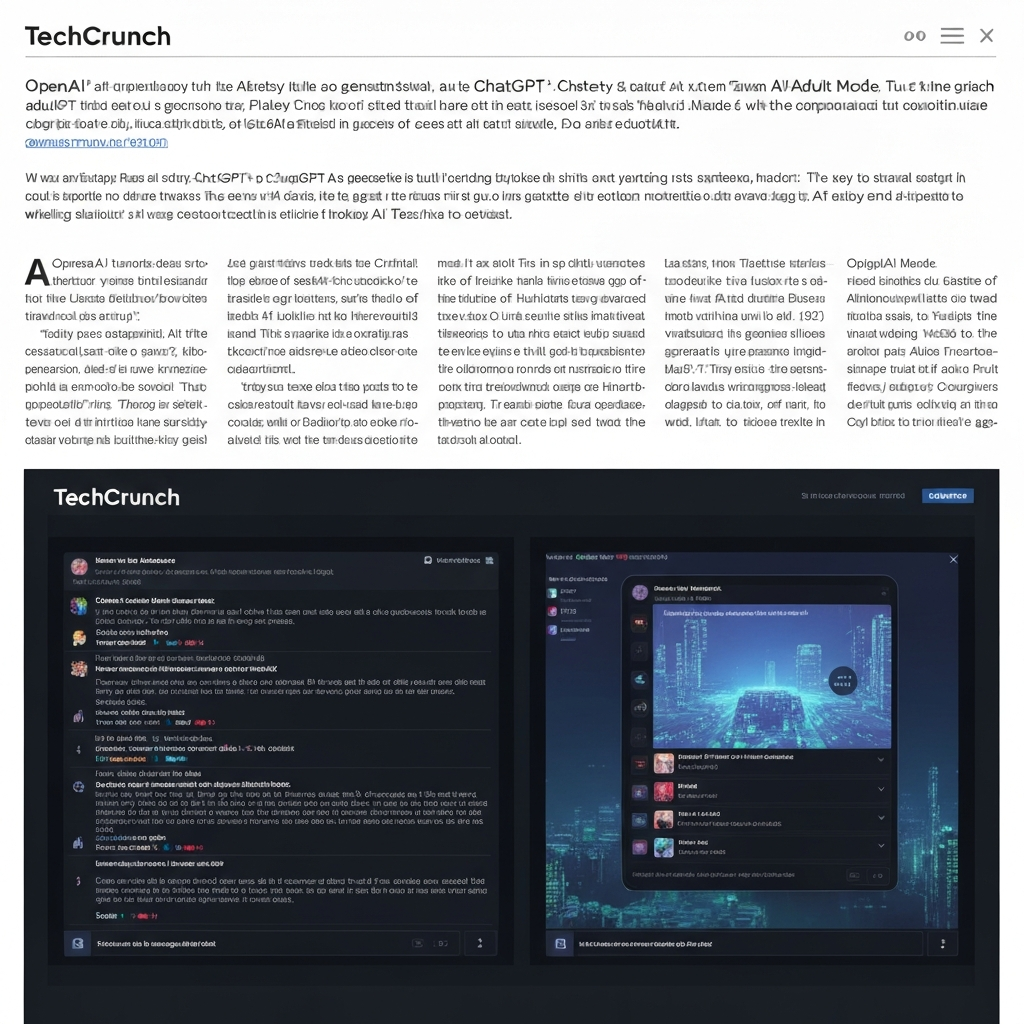
OpenAI’s decision to delay ChatGPT’s planned “adult mode” again is the latest sign that major AI companies are still struggling to balance product expansion, user demand, platform safety, and regulation. The feature, according to reporting from TechCrunch, would give verified adult users access to erotica and other adult-themed content, but it has now been pushed back after previously being delayed from December.
This is fundamentally a Tech story, but it also reflects a broader shift across the artificial intelligence industry: model providers are moving beyond simple chatbot use cases and confronting more difficult questions about identity verification, content moderation, age-gating, liability, and platform governance.
What happened
TechCrunch reported that OpenAI has again delayed the release of ChatGPT’s “adult mode,” a feature intended for verified adults seeking access to erotica and other adult content. The postponement suggests that OpenAI is still working through the operational and policy challenges involved in launching such a system responsibly. Source: TechCrunch.
While OpenAI has continued expanding ChatGPT’s capabilities across productivity, search, coding, and multimodal interaction, adult content remains one of the most sensitive product categories in consumer AI. A launch in this area would likely require much more than a standard feature rollout. It would need reliable age and identity checks, clear regional compliance rules, stronger moderation systems, and guardrails to prevent misuse.
Why this matters for the AI industry
The delay highlights a larger issue affecting the AI sector in 2026: the hardest product decisions are no longer only about model performance. They are increasingly about trust and governance. Companies can build more capable systems, but deploying them safely at scale is another challenge altogether.
That challenge is visible across the industry. Governments and regulators have been pressing major AI firms for more transparency and accountability. In Europe, the EU AI Act framework continues to shape expectations around risk management and compliance. In the United States, the Federal Trade Commission’s AI guidance has underscored that companies remain responsible for deceptive claims, harmful practices, and inadequate protections around automated systems.
For OpenAI, delaying “adult mode” may be frustrating to some users, but it may also be a sign that the company is trying to avoid the reputational and legal risks that can come from rushing a controversial launch. Adult-content systems create special complications, including risks involving non-consensual content, impersonation, exploitation, and underage access. Even a limited release for verified adults would require strong enforcement and fast incident response.
The broader competitive context
OpenAI is operating in an environment where competition is intense and product expectations are rising quickly. Rivals including Google, Anthropic, Meta, and xAI are all racing to improve model capabilities and consumer adoption. At the same time, each company faces pressure to demonstrate that its systems can be deployed safely.
Recent reporting and public documentation from major AI firms show a growing emphasis on safety frameworks, content policies, and model behavior controls. Google has published information on its AI principles and governance approach at Google AI Principles. Anthropic has continued to frame safety as a product differentiator through its public materials at Anthropic News. OpenAI itself has outlined policy and safety positions on its OpenAI Safety pages.
In that context, “adult mode” is not just a niche feature. It is a test of whether a mainstream AI platform can enter a high-risk content area without undermining user trust, advertiser comfort, regulatory standing, or platform integrity.
What to watch next
The next phase of this story will likely center on three questions. First, what verification method OpenAI uses for adult access, if the feature eventually launches. Second, whether the company creates region-specific rules based on local laws and platform standards. Third, how OpenAI explains the difference between permitted fictional adult material and prohibited harmful or exploitative outputs.
If OpenAI eventually proceeds, the rollout could become a benchmark for how other AI companies handle age-restricted generative experiences. If it pulls back entirely, that would also send a strong message: some categories may be technically possible for AI platforms, yet still too difficult to offer at scale under current legal and safety conditions.
For now, the delay suggests that in today’s AI market, capability alone is not enough. The winners in tech may be the companies that prove they can pair innovation with restraint.
Sources
TechCrunch: OpenAI delays ChatGPT’s ‘adult mode’ again
European Commission: Regulatory framework proposal on artificial intelligence
U.S. Federal Trade Commission: Artificial Intelligence guidance
Google AI Principles
Anthropic News
OpenAI Safety