



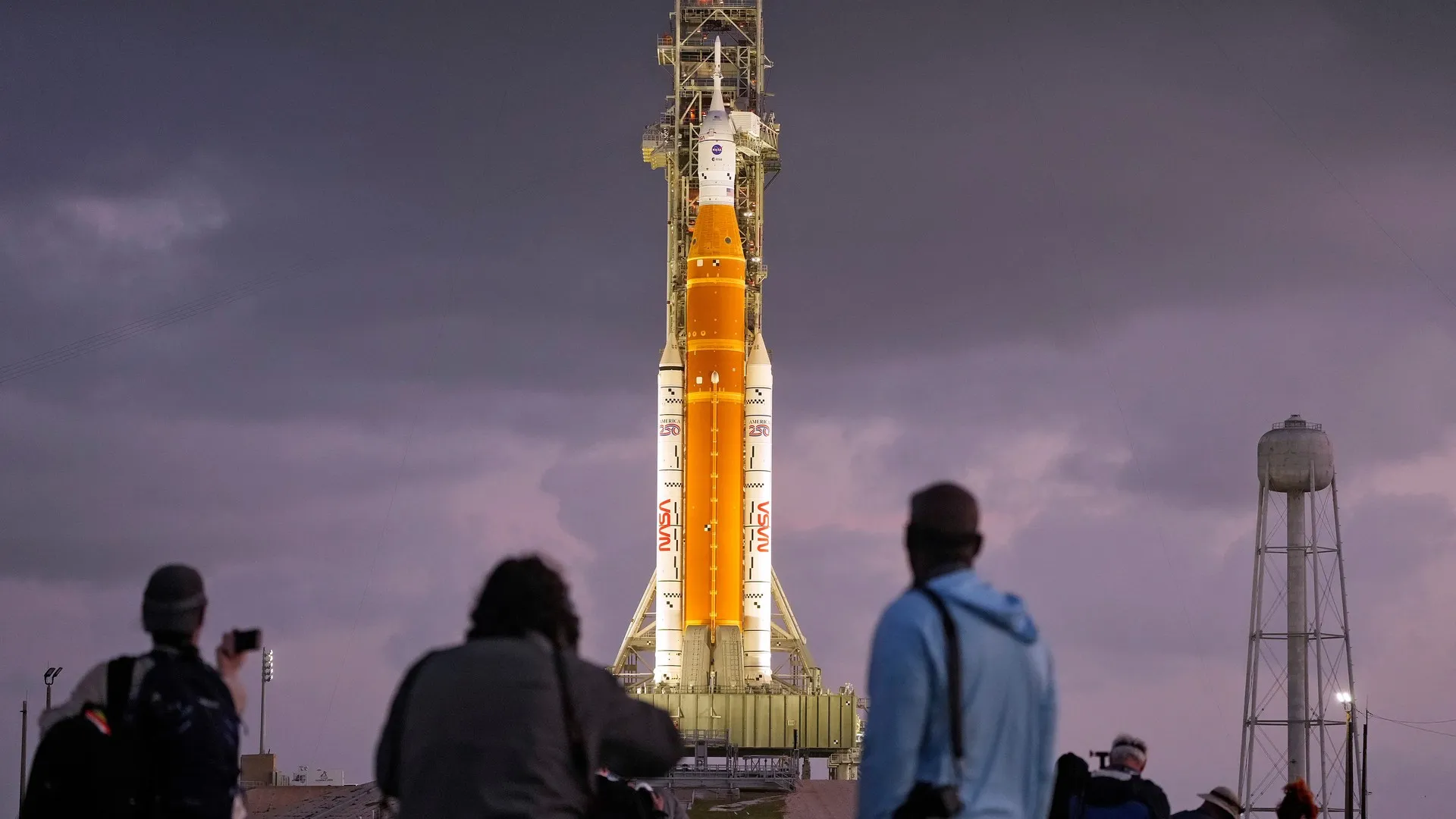
NASA is preparing to send humans around the moon for the first time since the Apollo era, marking a major milestone for the agency’s Artemis program and for international space exploration. Artemis II, scheduled as NASA’s first crewed lunar mission in more than 50 years, will carry four astronauts on a 10-day journey around the moon aboard the Orion spacecraft.
Why Artemis II matters
Unlike the Apollo moon landings, Artemis II is not designed to touch down on the lunar surface. Instead, the mission is focused on proving that NASA’s deep-space systems are ready for future lunar landings. The crew will test life-support operations, navigation, communications, and spacecraft performance far beyond low Earth orbit. According to NASA’s Artemis II mission overview, the flight is intended to validate the hardware and crew procedures that future Artemis missions will rely on.
The mission will send astronauts roughly 244,000 miles from Earth and thousands of miles beyond the far side of the moon before looping back using a free-return trajectory. That approach is both technically significant and symbolically powerful: it revives human deep-space travel at a time when multiple nations are accelerating their lunar ambitions.
The crew and its historic significance
The Artemis II crew includes NASA astronauts Reid Wiseman, Victor Glover, and Christina Koch, alongside Canadian Space Agency astronaut Jeremy Hansen. The lineup itself reflects how modern lunar exploration is becoming more international. Hansen is set to become the first non-American to travel beyond low Earth orbit, while Koch is expected to become the first woman to make such a journey. NASA introduced the crew in its official announcement, emphasizing both their operational experience and the broader representational significance of the mission. Source: NASA crew announcement.
That international aspect also mirrors the broader strategy behind Artemis. The program is not just about flags-and-footprints symbolism; it is tied to long-term plans for lunar infrastructure, scientific research, and strategic partnerships. Canada’s role, in particular, highlights how allied participation is being folded into NASA’s long-range moon architecture.
Latest science news: the global moon race is intensifying
Artemis II is launching into a far more competitive scientific landscape than the one NASA faced during Apollo. In recent years, the moon has re-emerged as a focal point for global space agencies and commercial space companies alike.
One of the most important developments has been the growing emphasis on the lunar south pole. Scientists believe the region may contain water ice trapped in permanently shadowed craters, making it potentially crucial for future human missions. Water could support astronauts directly and also be split into hydrogen and oxygen for rocket fuel. NASA has repeatedly identified the south polar region as a key target for future Artemis landings. Source: NASA Artemis program.
Meanwhile, other countries are making rapid progress in lunar exploration. China’s lunar program has steadily advanced through robotic missions, sample returns, and long-term planning for a research station on the moon. The return of far-side lunar samples by China’s Chang’e-6 mission underscored how quickly the scientific competition is evolving. Those samples could help researchers better understand the moon’s geology and the solar system’s early history.
Commercial industry is also reshaping the science landscape. NASA has increasingly leaned on private-sector partners for lunar cargo delivery and spacecraft development. Through programs such as Commercial Lunar Payload Services, the agency is trying to create a more sustainable model for repeated exploration rather than relying solely on single-government architectures. Background from NASA CLPS.
What Artemis II means for science beyond the headline
The most immediate headline is simple: humans are heading back around the moon. But the deeper scientific story is that Artemis II serves as a systems-validation mission for a much broader exploration era. If successful, it will help clear the way for Artemis III and later missions meant to support longer stays, more advanced lunar surface operations, and eventually a sustained presence in cislunar space.
That matters because lunar exploration is no longer viewed only as a prestige exercise. Scientists increasingly see the moon as a laboratory for planetary science, a proving ground for Mars missions, and a strategic location for future infrastructure. Deep-space radiation exposure, life-support durability, and long-duration mission planning can all be studied more effectively through lunar missions than through low Earth orbit operations alone.
There is also a practical lesson in Artemis II: before NASA can attempt another landing, it must demonstrate reliability in crew transport beyond Earth orbit. That makes this mission less about spectacle and more about confidence-building. In many ways, Artemis II is the bridge between ambition and execution.
Looking ahead
If launch and flight operations proceed as planned, Artemis II could become one of the defining science stories of the year. It represents a return to human deep-space exploration, but under modern conditions shaped by international cooperation, commercial participation, and renewed geopolitical competition.
The mission will be watched not only for its engineering performance but for what it signals about the next decade of exploration. A successful flight would strengthen NASA’s case that the Artemis architecture is viable and that the moon is once again becoming a central destination for science, strategy, and human discovery.
Sources: