



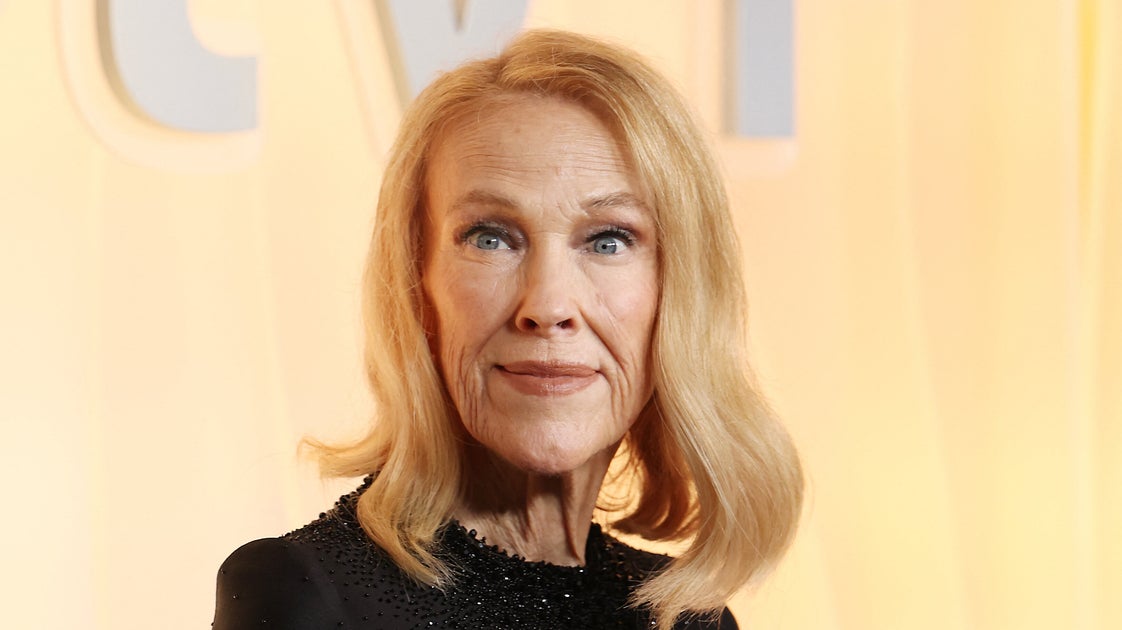
Catherine O’Hara at Apple TV+’s Primetime Emmy Party in West Hollywood, California, on Sept. 14, 2025.
“What’s your name?” Catherine O’Hara asked me, leaning forward in the booth. “What’s your story?”
I was standing in a swanky restaurant in New York City wearing a black dress short enough to satisfy management, my hands clasped behind my back in case a manager appeared. I had just broken the most important rule of the job: Never acknowledge a celebrity.
Three months earlier, I had dropped off my resume anywhere I could in hopes of securing a job that would supplement what my $35-a-week publishing intern stipend wouldn’t get me, which was, of course, everything but my subway fare.
I was hungry in every sense of the word. By the end of the day, I was offered three serving jobs and took them all. One was at this legendary restaurant continuously full of rock stars, Oscar-winning actors and models.
During my interview, the manager had ignored my flimsy (both in substance and content) resume and assessed my body instead. My waist. My chest. My legs. He said they had a place for me as a cocktail server in the private lounge where the windows were tinted, the tables were low and loungy, and the only clientele allowed in were ultra-wealthy patrons and celebrities.
The manager told me to show up later that night for my first training shift and emphasized that the dress code was all black, dresses only, hemlines not to exceed the end of my fingertips when my arms were hanging by my sides.
“We prefer the skirt to graze your first knuckles,” he said, making a fist and pointing to the ridged top of his hand to make his point.
I was 22, fresh out of college, and ready to do whatever it took to become a writer. If I can make it here… I thought.
When I walked in for my first shift, I was surprised to see a friend from college working at the host stand. Back in Colorado, he’d been a boisterous theater kid — lanky with bright blue eyes and flamboyant energy. Now he looked hollowed out — dark under the eyes, less “youthfully thin” and more underfed. He seemed tired and nervous, and his eyes flicked around as if we might get in trouble for hugging.
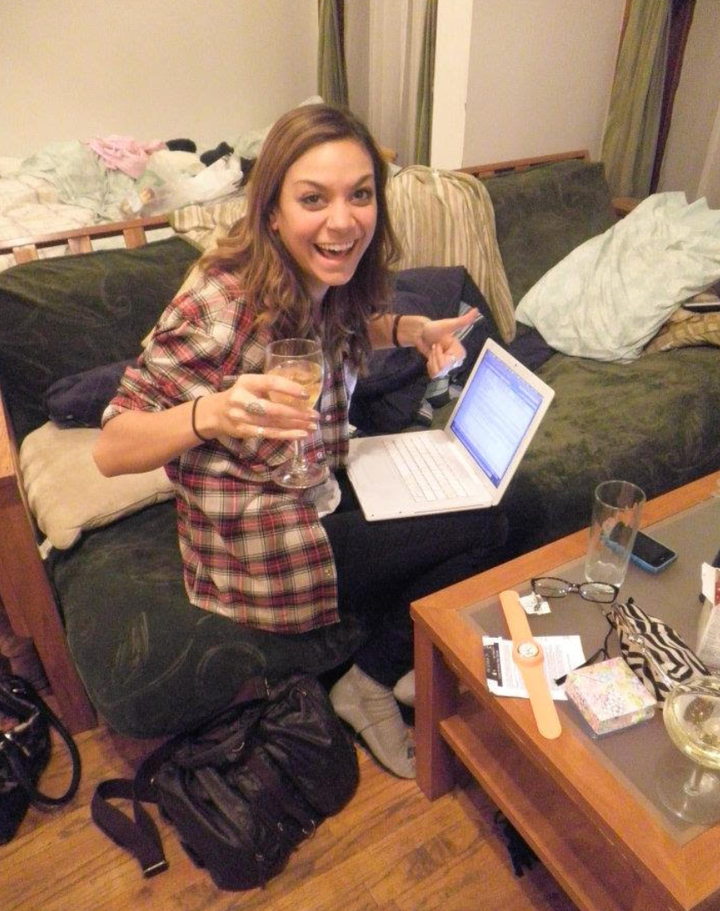
The author celebrating her first story being accepted for publication in 2011 — a year before she decided to move to New York City.
The server I was assigned to shadow approached the host stand to retrieve me. She was gorgeous, waifish, and in place of the air of sadness my college acquaintance had, she’d built a bitter bubble of sarcasm around herself.
She walked me quickly through the labyrinthine back-of-house, dodging catcalls from her co-workers and managers deftly. She listed off rules as I struggled to keep up. Three of them stuck out.
1. We were required to try everything on the menu, which perked me up as a hungry, broke person used to only eating family meal slop before a shift.
2. We were a “pooled house,” which meant the managers gathered and then divvied up our tips (after shaving a cut).
3. We were not allowed — under any circumstances — to reveal that we recognized a celebrity. We were to treat everyone as an anonymous guest. Asking for an autograph, a photo, or even announcing that you were a fan of anyone famous would result in immediate termination.
Perhaps this last rule sounds easy enough to follow, but during my first training shift, Jay-Z, Adam Sandler and Mariah Carey were among our guests.
I lasted one month at this restaurant. Long enough to eat my way through the menu and gather enough celebrity run-in anecdotes to last a lifetime. My cocktail party stories suddenly involved run-ins with Bill Belichick, Jon Bon Jovi, Jonah Hill and Josh Hartnett, among many, many others. But not even these exciting encounters could make up for the depleting atmosphere of working in a place where every staff member was a hopeful singer, model, actor or artist.
After my first shift, I witnessed the server who was training me earn over $1,000 in tips — then walk out the door with only $220 after management’s cut. When I asked about the tip breakdown, my manager was finishing a line of cocaine in his windowless basement office. His explanation made little sense, but he laughed at my confusion, and I left his office feeling dejected and violated.
However, what really convinced me that I couldn’t survive there long was when I realized that my co-workers all seemed to be struggling with disordered eating. Years earlier, after my dad had died suddenly of a heart attack, I’d developed my own eating disorder — a coping mechanism that came with consequences. I’d slowly healed in college, partly thanks to a tight circle of wonderful friends. Now, without them and being surrounded by behaviors that I instantly recognized as potentially damaging, I felt my anxiety rising in a new — though disturbingly familiar — way.
During my work shifts, my trainer-server and I worked through the restaurant’s menu, each night picking something new for me to try, and we’d sit on the back staircase (there was no break room) while she explained the dish to me. No matter what it was — tuna on crispy rice, a black truffle pizza, half a roast chicken on a mountain of garlic mashed potatoes — she refused to have a bite.
“No way. I’m trying to be an actress,” she told me. “I wouldn’t even eat a cucumber here. They put sesame oil on everything.”
She joked about it — “I don’t eat, really. None of us do.”
Though I wasn’t attempting to make it as an actress, I still began to leave food on the plate, uneasy about doing so, but also worried she might have a point. She was putting her goals first. Hunger as discipline. Emptiness as a badge of ambition. Maybe fed girls didn’t make it in NYC.

The author right after she moved to New York City in 2012.