



A dermatologist, two plastic surgeons and professional makeup artists explain what’s going on in the widely circulated image.
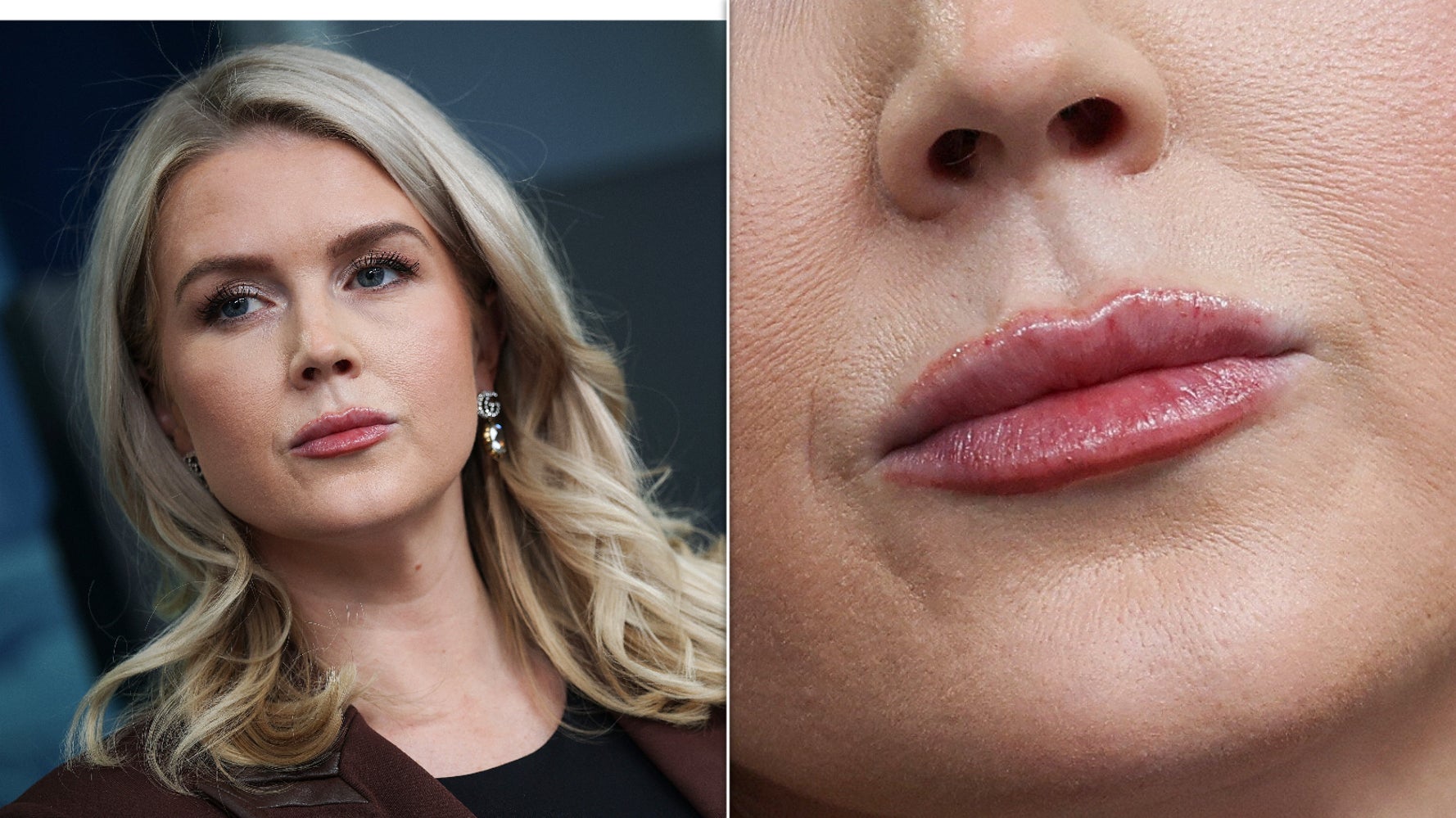
A close-up photo of Karoline Leavitt from Vanity Fair’s stunning pieces about White House officials got a lot of attention this week for revealing what appear to be familiar dots around the press secretary’s lips.
The comments section for Vanity Fair’s Instagram post includes responses like, “The injection marks really sing in this one!” and “Love the evidence of her gender-affirming care.”
This is not the first time Leavitt’s cosmetic choices have sparked conversation. And as many have pointed out on TikTok and beyond, “conservative girl makeup” and “Mar-a-Lago face” have become politically coded beauty trends in our culture.
The extreme close-up ― an approach not limited to Leavitt in the article, and which photographer Christopher Anderson has defended as a signature feature of his political portraiture ― offers a glimpse into the cosmetic choices involved in these beauty trends.
To better understand what viewers were reacting to, HuffPost asked a dermatologist, two plastic surgeons and some professional makeup artists to explain what might be going on and how to avoid the look yourself.
Here’s what doctors see in the photo.
“I’m not her doctor, but it appears as though those red spots are a vascular response to needle entry points used to deliver a soft tissue filler to the vermilion border of her upper and lower lips,” said Dr. Corey L. Hartman, a dermatologist and founder of Skin Wellness Dermatology.
Different injectors favor different lip filler techniques, and outcomes can vary widely based on skin sensitivity, timing and aftercare.
“It looks like a serial puncture technique, which is certainly a choice, but this would be on the higher end of injection sites,” Hartman added. “I don’t use this technique, but if I did, I would try to minimize the number of sticks, particularly if they leave behind small telangiectasias like this.”
Telangiectasias are tiny, dilated blood vessels that appear as darker spots on the lips. Because lips are a vascular area, bruising and similar effects aren’t uncommon after injections.
“The marks are likely from very recently injected lip filler, like the same day or the day before the photo shoot,” echoed plastic surgeon Dr. Anita Kulkarni. “This is called the ‘picket fence’ technique where lip filler is injected with a small needle vertically along the length of the lip to add height and volume to a short lip. The needle marks are not usually this visible, so she likely has some inflammation in that area that may be from sensitive skin and the needle.”
Many commenters ironically characterized the apparent evidence of lip filler as “gender-affirming care,” which has become a flashpoint under the Trump administration.
Kulkarni does not typically use the picket fence technique herself.
“I prefer to vertically inject only at the cupids bow to add height and then inject horizontally through the lip for volume,” she said. “You can’t avoid needle marks any time you use a needle to pierce the skin, but they can be minimized by using a very small needle and they typically disappear pretty fast.”
Kulkarni believes Leavitt appears to be within one to three days of filler treatment based on the photo. She noted that needle marks from lip injections tend to resolve within a few days.
“The lips looks swollen and lumpy, which would be consistent with fresh lip filler,” she said, pointing to a popular social media infographic that shows the life cycle of lip filler. “We recommend patients give it four weeks between filler and any important event like a wedding, gala ― or Vanity Fair photo shoot!”
Plastic surgeon Dr. Frederick Weniger believes the marks aren’t necessarily from injectables at all, however.
“More likely explanations include irritation from lip products or exfoliants, dehydration combined with gloss, cold weather, retinoid use or even recent dental work,” he said. “Harsh lighting and extreme close-up cropping can also amplify normal texture and color variation, creating the illusion of an issue where there may be none.”
He noted that common short-term changes to lips after injections include swelling, tenderness and occasionally small bruises at needle entry points.
“When patients do develop visible marks after treatment, they are more often related to secondary factors,” Weniger said. “This can include irritation from antiseptic prep, frequent wiping of the lips, pressure from masks, dehydration, or reacting to lip products applied too soon after injections. The skin around the mouth is delicate and easily inflamed, especially if it is already dry or sensitized.”
He added that these kinds of surface changes are generally avoidable with good technique and aftercare.
“That means gentle handling during injections, minimal trauma, avoiding harsh products afterward and keeping the lips well hydrated,” Weniger said. “When they do occur, they almost always fade on their own as the skin barrier recovers. They are not permanent and are not a sign of a problem with the filler itself.”
Makeup artists have thoughts about the lip coverage choices.
The makeup artists who spoke to HuffPost noted that certain product choices and application techniques can make post-injection lip texture far more visible, especially under harsh lighting and high-resolution photography.
“In the Vanity Fair photo, her lips appear swollen and look as if there are little needle marks, which are typical after having a lip augmentation,” said makeup artist Michelle Phillips. “If someone has had their lips done and is going on camera shortly afterward, the key is to use an opaque lipstick rather than a sheer gloss, which obviously highlighted the needle marks.”
She also pointed to liner placement as an issue.
“Typically, Karoline’s lip liner and lipstick are applied above the cupid’s bow and below the natural lower lip line,” she said. “I’d move away from the drawn-on liner look and avoid extending so far above and below the natural lip line.”
Makeup artist Bryan Cantor echoed that certain lip products can make texture more obvious.
“Her lipstick is too sheer for her, and you can see the puncture marks where she had her lips injected, and she did not use a lip liner to correct her lip shape after the injections,” he said. “I would use a lip pencil to correct her lip shape and follow that up with an opaque lip color to fully camouflage her lip injections.”
As the photographer noted, Leavitt had “her own personal groomer” present at the shoot, and most of the subjects arrived camera-ready or with their own hair and makeup teams.
Kriss Blevens, a makeup artist who regularly works with clients post-procedure, emphasized that concealment often requires going bolder, not lighter.
“I have to conceal medical intervention often, so I use a paramedic grade concealer around the lip line,” she said. “And my secret to camouflaging injection sites is to use a matte long lasting lip color that is pigmented but darker than the bruise. The color and the look may look a little bit more dramatic, even vampy, but it will fully hide yesterday’s work while things heal. No one will know.”