




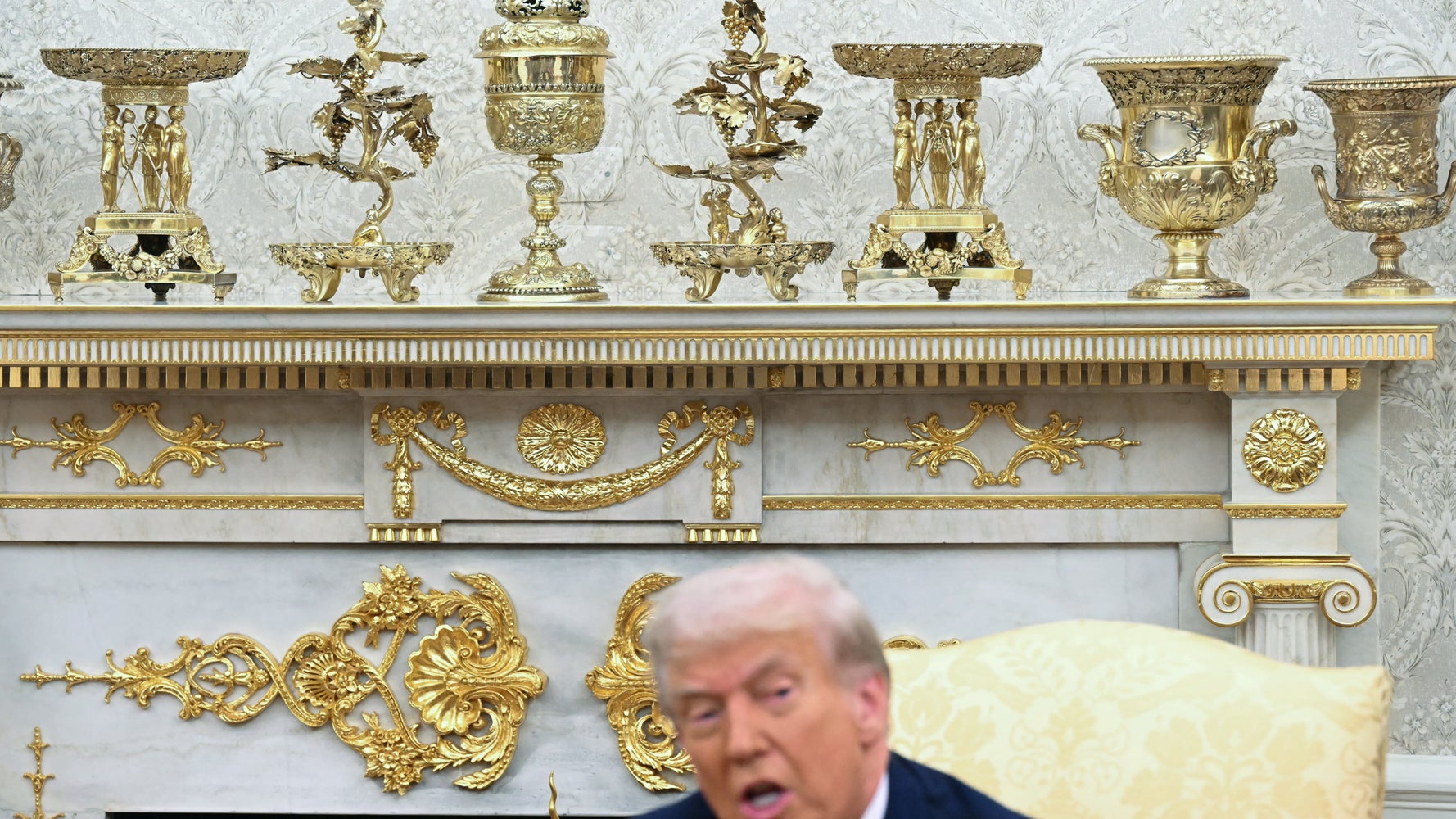
President Donald Trump’s dramatic changes to the design of the White House have sparked widespread attention and plenty of outrage.
From the gold-heavy Oval Office to the newly renovated presidential bathroom and the controversial ballroom project, his updates bring a distinctive aesthetic that critics say clashes with the historic White House architecture. Some have compared it to a suburban Thai restaurant, a tacky casino or a theatrical set ― emphasizing spectacle over subtlety.
HuffPost spoke with interior designers and art experts to unpack what these choices reveal about taste, power and the personal brand of the president behind them.
The vibe is ‘let them eat cake.’
“My first impression was that the redesign completely ignored the architecture it sits inside,” said interior designer Sarah Boardman. “The White House is a blend of Palladian and Georgian neoclassical design, with beautifully restrained Irish influences, soft curves, elegant proportions and detailed plasterwork that already provide all the ornament the room needs.”
She noted that past presidents have generally honored that foundation, even if they opted for slightly bolder carpets or richer fabrics.
“This redesign goes in the opposite direction,” Boardman said. “The gold isn’t integrated into the architecture ― it’s layered on top of it. The appliqués and ornaments look like they were purchased in bulk and installed everywhere instead of being thoughtfully selected. It has far more in common with French Baroque and Rococo, the Versailles ‘let them eat cake’ era, than anything in the White House’s actual design lineage.”
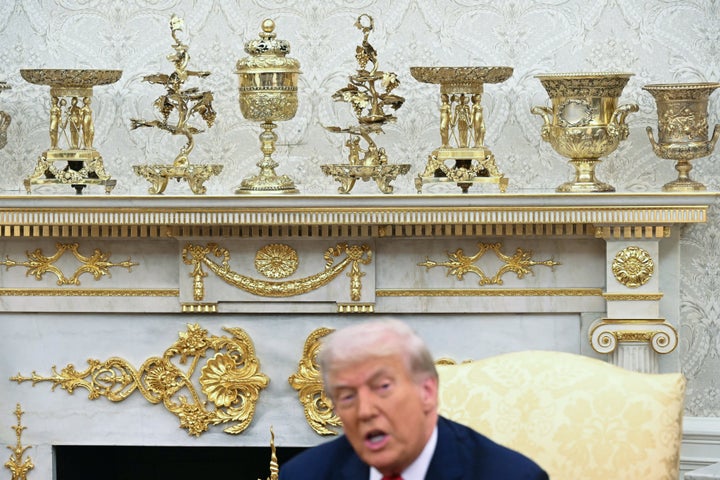
The Trump administration’s Oval Office redesign notably features a dramatic profusion of gold-colored ornamentation and other embellishments.
Art historian Robert Wellington, author of “Versailles Mirrored: The Power of Luxury, Louis XIV to Donald Trump,” said the aesthetic echoes not just Versailles specifically, but a broader European palace tradition that was later co-opted by America’s Gilded Age elites.
“Trump has long shown an interest in the Louis XIV style, the look and feel people associate with Versailles,” Wellington said. “What I actually see is a tradition that builds on European palace design meant to signal princely magnificence. In the Gilded Age, America’s robber barons borrowed those strategies to telegraph their own social ascendance. Trump is drawing from that and essentially bringing his kind of corporate-branding strategy to the White House. The idea is that if he surrounds himself with luxurious things, it shows he’s the kind of person who should lead the country.”
Interior designer Kelley Wagner ― who has posted many TikTok critiques of the current president’s design choices ― also drew comparisons to Louis XIV’s Versailles and even the lavish interiors shown in images of Vladimir Putin’s purported residence.
“Both the Sun King’s Versailles and Putin’s home are ‘palaces,’ and were not designed to be public spaces,” she said. “It’s my belief that President Trump has a personal affinity for these motifs because he believes they convey opulence and power.”
What makes the Versailles-esque approach particularly jarring, designers said, is how sharply it contrasts with the building it occupies, both symbolically and visually. Wagner noted that the Rococo-style gold appliqués now covering the space feel fundamentally mismatched.
“The sinewy motifs are at odds with the neoclassical style, which focuses more on geometric shapes,” she said. “Additionally, the direct application of these pieces onto the wallpaper, marble fireplace surround and the gold leafing of existing elements is a bit unconventional.”
The spectacle is the point.
“Throughout the ages, the heavy use of gold has been designed to convey wealth and power,” said Zoe Warren, an interior design expert with PriceYourJob.co.uk. “For Trump, the use of gold is about conveying a sense of success in both business and politics.”
She added that Trump’s gold aesthetic is “undeniably opulent” — a deliberate choice meant to impress and add drama in the style of Baroque interiors. Because people perceive gold as inherently high-value, its heavy use could create an immediate sense of grandeur.