



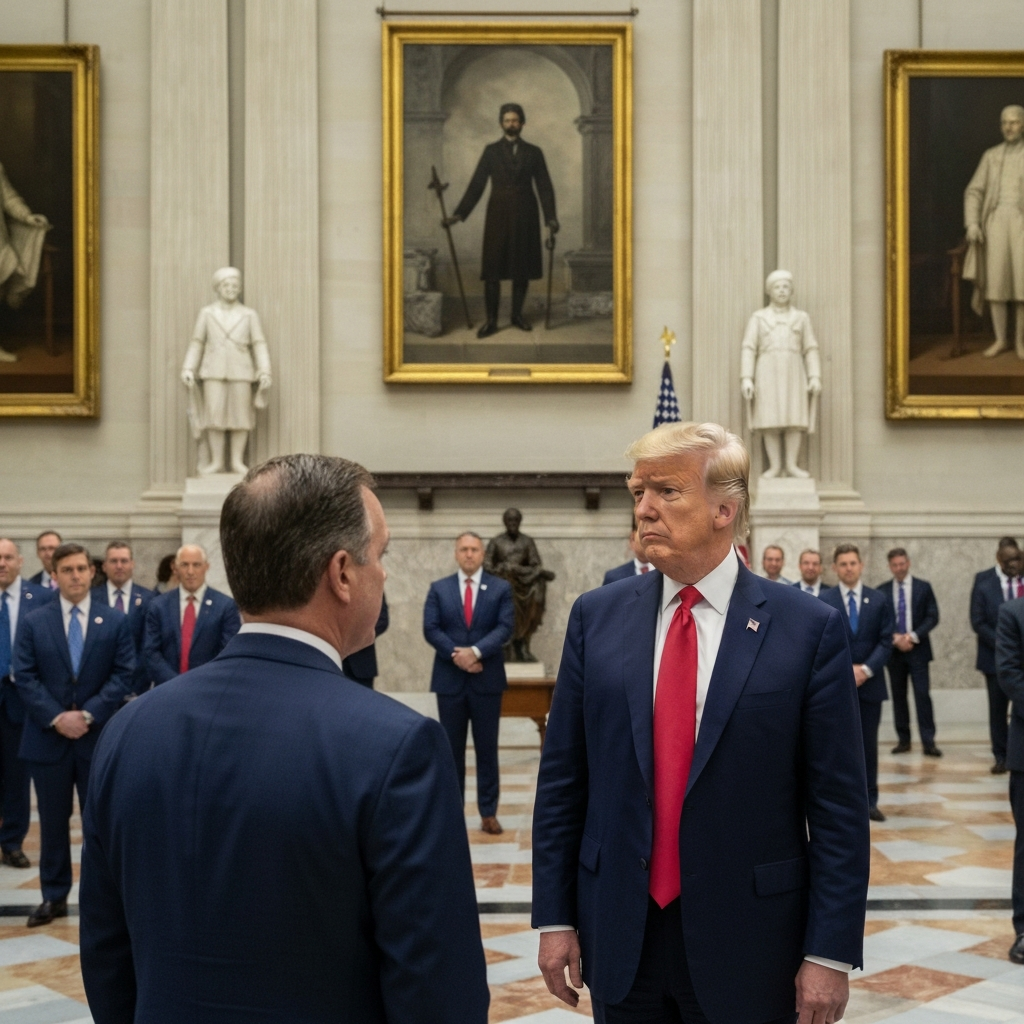
President Donald Trump said he wants a say in who leads Iran next, escalating already extraordinary rhetoric around the U.S. role in the widening regional conflict.
According to reporting from [NBC News](https://www.nbcnews.com/politics/donald-trump/wants-iran-leadership-structure-gone-preference-good-leader-rcna262039) and [Axios](https://www.axios.com/2026/03/05/iran-leader-trump-khamenei), Trump said he wants Iran’s current leadership removed and argued he should be involved in selecting a successor. He also said Mojtaba Khamenei, son of the late Ayatollah Ali Khamenei, would be “unacceptable” as Iran’s next leader.
## Trump escalates rhetoric on Iran
Speaking publicly and in media interviews, Trump called on members of Iran’s Revolutionary Guard, military, and police to stop fighting, while warning that continued resistance would bring devastating consequences. His comments go beyond military pressure and suggest an openly interventionist posture toward Iran’s political future.
That stance is likely to deepen debate in Washington and abroad over whether the United States is pursuing limited military objectives or something much broader: regime change.
Trump’s remarks came as Iranian officials delayed naming a successor, though figures in Tehran reportedly signaled an announcement could come soon. The uncertainty around succession has added another layer of instability to an already volatile confrontation involving Iran, Israel, the United States, and Iran-backed armed groups across the region.
## Congress fails to restrain presidential war authority
On Capitol Hill, the U.S. House narrowly rejected a war-powers resolution in a 212-219 vote that would have limited Trump’s ability to order further strikes on Iran without congressional approval, according to the [Associated Press](https://apnews.com/article/house-vote-iran-war-powers-resolution-trump-5d7d93c7793802881d9cde042220d7bc).
House Speaker Mike Johnson argued it would be dangerous to curb presidential authority while U.S. forces are already engaged. Opponents of Trump’s position countered that the Constitution gives Congress, not the president alone, the power to decide whether the country enters war.
The failed vote underscores a familiar tension in American politics: presidents of both parties have steadily expanded unilateral military power, while Congress has often struggled to reassert its authority after hostilities begin.
Even if the House measure had passed, its chances of becoming law were slim after the Senate rejected a similar effort. Trump also would have been expected to veto any final bill restricting his options.
## Israel widens strikes as regional pressure grows
The broader conflict also intensified Friday. The [Israeli Defense Forces](https://www.idf.il/) said Israel launched a “broad-scale” new wave of strikes against Iranian regime infrastructure in Tehran, while also hitting Hezbollah-linked targets in Lebanon.
Israeli officials said the operations included attacks in Beirut’s Dahieh area targeting Hezbollah infrastructure, including what they described as a command center and facilities linked to unmanned aerial vehicles.
Lebanon’s leadership warned that the country faces a worsening humanitarian emergency. Reuters has separately reported in recent regional coverage that cross-border strikes involving Israel, Hezbollah, and Iran-aligned forces have raised fears of a broader war stretching well beyond Gaza and southern Lebanon. For wider background on the regional security picture, see recent coverage from [Reuters](https://www.reuters.com/world/middle-east/) and [BBC News](https://www.bbc.com/news/world-middle-east).
## Why this matters
Trump’s comments matter not only because of their immediate diplomatic impact, but because they clarify a possible U.S. endgame. Publicly discussing who should govern Iran moves the conversation from deterrence and retaliation to political engineering.
That has several implications:
– It may harden resistance inside Iran by allowing the regime to frame unrest or opposition as foreign-directed.
– It complicates U.S. relations with allies that may support military containment of Iran but not overt involvement in selecting its leadership.
– It sharpens the constitutional fight in Washington over who decides when limited military action becomes open-ended war.
Historically, outside powers have often underestimated how difficult political transitions become when leadership change is associated with foreign pressure. That does not mean Iran’s internal politics are static or that succession questions are unimportant. It does mean that rhetoric about picking leaders can carry consequences far beyond the news cycle.
## What to watch next
Several near-term developments could shape the next phase of the crisis:
### 1. Iran’s succession announcement
If Tehran names a new leader soon, the choice will be scrutinized for signs of continuity or fracture within the regime.
### 2. U.S. military posture
Any additional strikes, force movements, or White House statements could indicate whether Washington is moving toward a sustained campaign.
### 3. Congressional response
Lawmakers may continue trying to force debate over presidential war powers, especially if U.S. involvement deepens.
### 4. Israel-Lebanon escalation
Further strikes on Hezbollah targets could pull Lebanon deeper into the conflict and intensify humanitarian concerns.
## Bottom line
The latest developments point to a conflict that is becoming more political, more regional, and potentially harder to contain. Trump’s insistence that he should influence Iran’s succession marks a significant rhetorical escalation, while Congress’s failure to pass a war-powers restriction leaves the White House with broad room to maneuver.
As military operations continue and Tehran edges toward a leadership decision, the central question is no longer just how this conflict is being fought — but what political outcome the major players are trying to impose.
### Sources
– [NBC News: Trump says he wants Iran leadership structure gone](https://www.nbcnews.com/politics/donald-trump/wants-iran-leadership-structure-gone-preference-good-leader-rcna262039)
– [Axios: Trump says he should be involved in choosing Iran’s next leader](https://www.axios.com/2026/03/05/iran-leader-trump-khamenei)
– [Associated Press: House vote on Iran war powers resolution](https://apnews.com/article/house-vote-iran-war-powers-resolution-trump-5d7d93c7793802881d9cde042220d7bc)
– [Israeli Defense Forces official site](https://www.idf.il/)
– [Reuters Middle East coverage](https://www.reuters.com/world/middle-east/)
– [BBC News Middle East](https://www.bbc.com/news/world-middle-east)