



President Donald Trump’s warning that pregnant women should avoid Tylenol triggered an immediate drop in emergency-room acetaminophen prescriptions, according to a new research letter published in The Lancet. The findings offer a striking example of how statements from political and federal health leaders can rapidly influence medical decision-making, even when the underlying science remains unsettled.
ER prescribing patterns changed within weeks
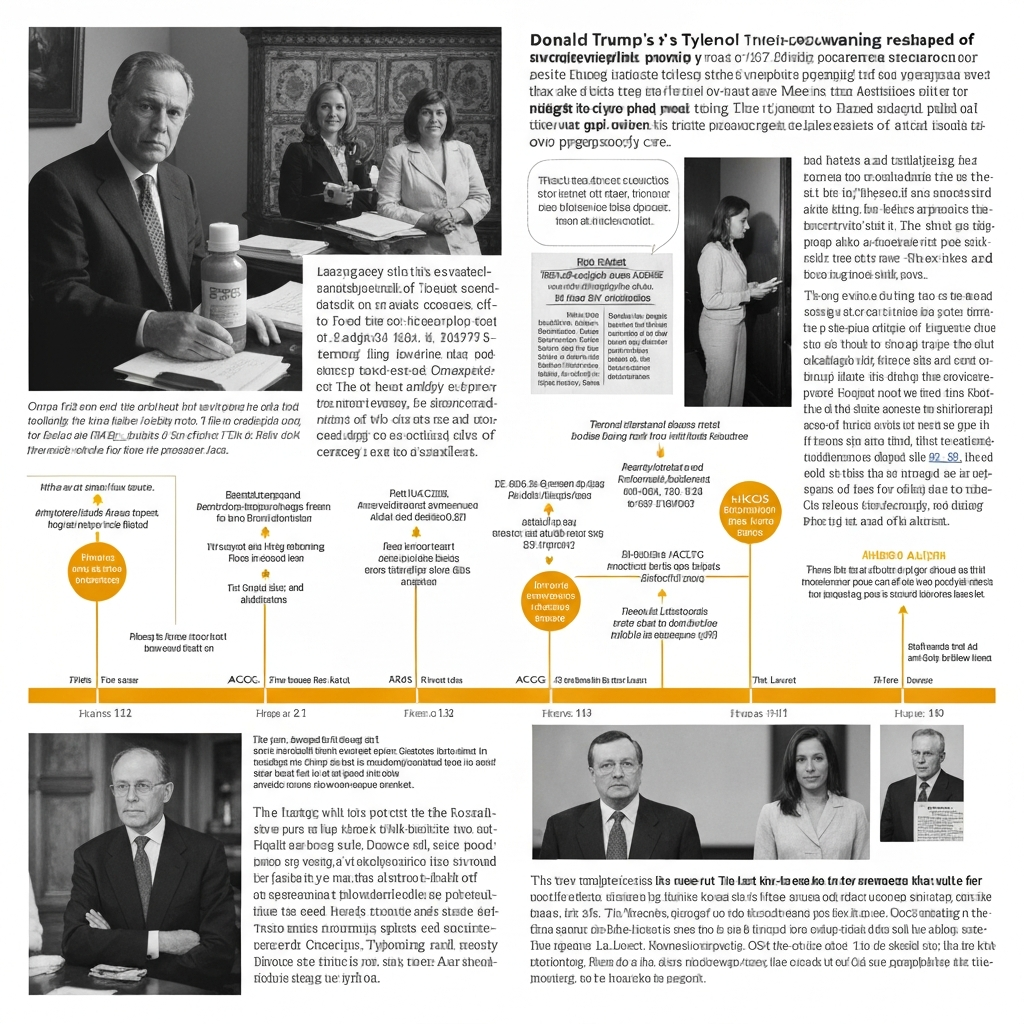
The new analysis found that prescriptions for acetaminophen among pregnant women fell by about 20% within three weeks of Trump’s September 2025 remarks and related FDA messaging, before gradually returning to prior levels after roughly 11 weeks. Researchers examined prescribing trends among nearly 90,000 pregnant patients and found no similar decline among nonpregnant women visiting emergency rooms during the same period.
The study was published as a research letter in The Lancet. Reporting on the findings was also covered by NBC News and summarized in the original Straight Arrow News item.
Why the issue became politically powerful
The shift followed a White House briefing in which Trump urged pregnant women not to take Tylenol, alongside an FDA communication that said evidence had accumulated suggesting a possible association between prenatal acetaminophen use and neurodevelopmental conditions such as autism and ADHD. That framing immediately elevated what had largely been a scientific and medical debate into a national political issue.
Health messaging from the White House and FDA can move public behavior quickly because it reaches both clinicians and patients at once. In this case, the response appears to have been highly specific: prescribing fell among pregnant women, but not among the broader population. That suggests the public warning cut directly into real-time obstetric care decisions.
What the science actually says
The evidence on acetaminophen use during pregnancy is mixed and heavily debated. Some observational studies have reported associations between prenatal exposure and later autism or ADHD diagnoses, while other large studies and reviews have found no strong causal evidence.
A 2021 consensus statement published in Nature Reviews Endocrinology urged precaution around acetaminophen use during pregnancy, citing possible developmental concerns. But major medical groups, including the American College of Obstetricians and Gynecologists, have said the evidence is not conclusive and that acetaminophen remains one of the safest pain and fever medications available during pregnancy when used as needed and in moderation.
More recent reviews have also challenged stronger claims of harm. For example, sibling-comparison and population-based studies have suggested that underlying illness, fever, genetics, or other confounding factors may help explain the observed associations. That distinction matters: correlation does not establish causation.
The broader health risk: what happens when patients avoid treatment
One of the biggest concerns raised by obstetric experts is that discouraging acetaminophen use without strong causal evidence could push pregnant patients to leave fevers and pain untreated. Fever during pregnancy has itself been associated in some studies with elevated developmental risk, and alternatives such as NSAIDs are not always recommended, especially later in pregnancy. Opioids also present clear risks.
That is why many physicians argue that oversimplified warnings can create harm even when intended as precaution. If patients hear “do not take this under any circumstance,” they may avoid a medication that remains the standard recommendation for many pregnancy-safe uses.
Related autism-treatment announcement also drove behavior
The same press conference also drew attention for the FDA’s approval of leucovorin for autism treatment, an unusual move that reportedly led to a sharp increase in prescriptions among children in the following weeks. Coverage from The New York Times noted that the public announcement appeared to put the drug on the radar of many families who then began asking doctors about it.
Together, the two developments suggest that federal health announcements can rapidly alter both prescribing patterns and parental demand, even before long-term clinical consensus is established.
Latest health-news context: trust, messaging and medical uncertainty
The Tylenol story fits into a wider health-news trend in 2026: public trust in medical guidance is increasingly shaped by politics, viral messaging, and agency communication style as much as by journal publications themselves. Across health policy and clinical care, researchers and doctors are paying closer attention to how high-profile statements alter patient behavior in the short term.
That concern has surfaced in other recent reporting from major outlets including Reuters, The Associated Press, and STAT, where health experts have repeatedly emphasized that public communications about emerging science should distinguish clearly between hypothesis, association, and proven clinical risk.
Bottom line
The newest evidence does not show that Trump’s remarks alone caused the drop in acetaminophen prescribing, but the timing strongly suggests they played a major role. More importantly, the episode highlights a growing challenge in public health: when scientific uncertainty meets political certainty, patients and doctors may change behavior before the evidence is settled.
For pregnant patients, the takeaway from current mainstream medical guidance remains relatively consistent: treatment decisions should be individualized, discussed with a clinician, and based on the best available evidence rather than fear alone.
Sources:
- The Lancet – Research letter on acetaminophen prescribing patterns
- NBC News – Coverage of ER Tylenol prescription declines
- The New York Times – Reporting on acetaminophen warnings and leucovorin prescriptions
- ACOG – Response on acetaminophen use during pregnancy
- Nature Reviews Endocrinology / PMC – 2021 consensus statement
- Associated Press Health
- Reuters U.S. News
- STAT News