


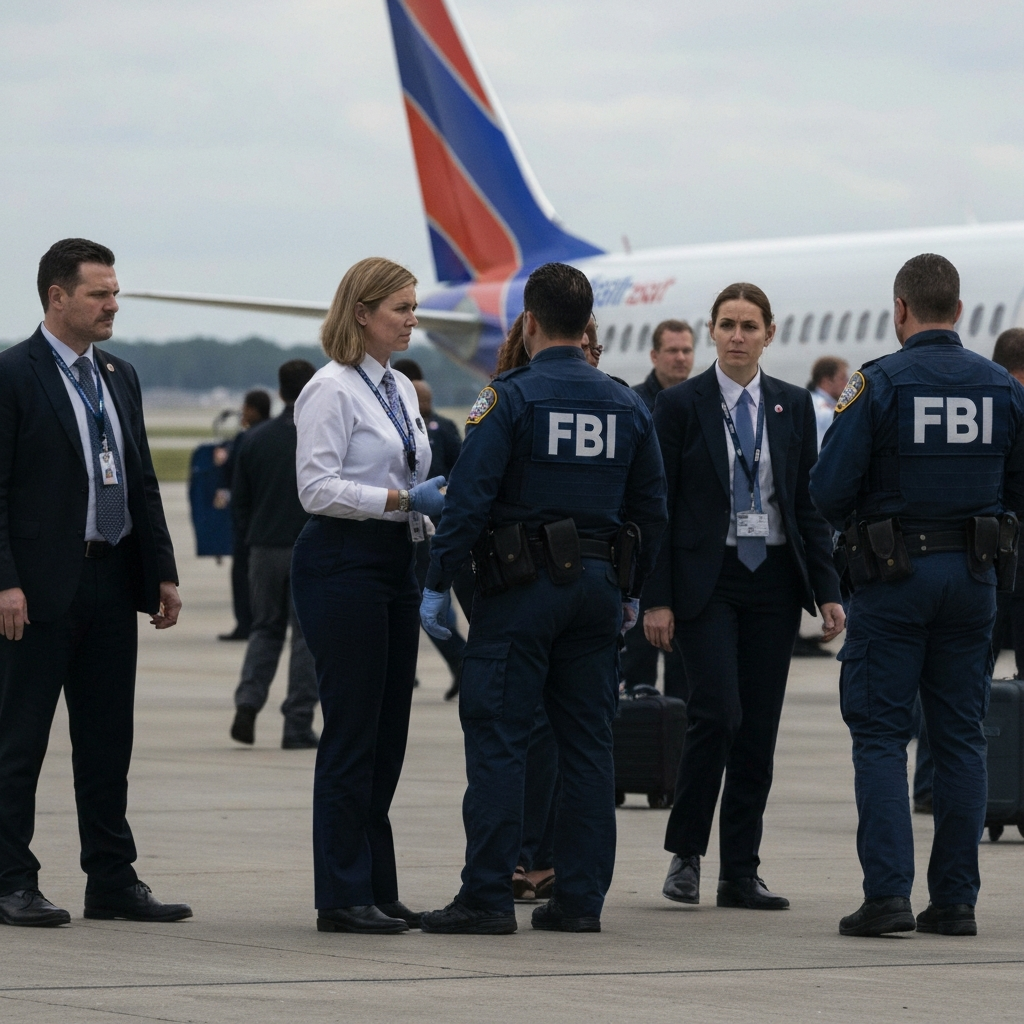
A Southwest Airlines flight diverted to Atlanta after what authorities described as a possible security matter, leading to an armed response that terrified passengers and quickly drew widespread attention online. The incident, involving Southwest Flight 2094 traveling from Nashville to Fort Lauderdale, ended with one passenger detained, interviewed by authorities, and later released without charges after investigators found no credible threat.
What happened on the Southwest flight
According to the Federal Aviation Administration, the flight landed safely at Hartsfield-Jackson Atlanta International Airport after the crew responded to a passenger disturbance. Videos shared by passengers on social media showed tactical officers boarding the aircraft and ordering travelers to keep their heads down and hands visible while they removed the individual in question.
The FBI Atlanta Field Office later said it worked with the Atlanta Police Department to investigate the situation and interview the passenger. Authorities concluded there was no credible threat and said no charges would be filed. Witness accounts suggested the incident may have begun after tension over a carry-on bag and text messages that other passengers believed looked threatening, though officials have not publicly confirmed those details.
Why this matters for airlines and travelers
While the immediate threat was ultimately deemed non-credible, the episode underscores a broader reality for the airline industry: crews and security officials are operating in an environment where even ambiguous behavior can trigger a full-scale emergency response. Airlines have spent years balancing customer experience with escalating security expectations, stricter onboard conduct policies, and growing operational strain.
That pressure is not isolated to one carrier. Across the industry, airlines continue to face high scrutiny over passenger behavior, emergency diversions, and disruption management. The FAA’s unruly passenger enforcement updates show that federal regulators remain focused on incidents that can affect crew safety and flight operations. Even when no charges result, diversions and law-enforcement responses can create major downstream costs, scheduling disruptions, and reputational fallout for airlines.
The latest business backdrop for airlines
The Southwest incident lands at a time when the airline business is already navigating a difficult mix of cost pressure, operational reliability concerns, and shifting travel demand. U.S. carriers have recently been contending with higher labor costs, aircraft delivery delays, air traffic constraints, and geopolitical disruptions affecting routes and traveler confidence.
Southwest itself has remained under close watch from investors and industry observers as it works to improve operational resilience and profitability. In recent company updates and investor materials, the airline has emphasized efficiency initiatives, network adjustments, and efforts to strengthen performance after previous disruptions. For broader industry context, recent reporting from Reuters’ aerospace and defense coverage and The Wall Street Journal’s airline coverage has highlighted how carriers are under pressure to maintain reliability while keeping costs in check.
Meanwhile, security-related diversions carry costs beyond fuel and logistics. They can require coordination with airport authorities, law enforcement, baggage re-screening, replacement aircraft or crews, and customer reaccommodation. For passengers, what should be a short domestic trip can quickly become an hours-long ordeal. For airlines, these moments reinforce how thin the margin can be between routine service and a highly disruptive event.
Social media’s role in aviation incidents
Another striking aspect of the Atlanta diversion is how quickly the story spread through viral passenger videos. In today’s travel environment, airline incidents often unfold in real time on TikTok, X, and Instagram before carriers or officials issue formal statements. That changes the pressure dynamic for both airlines and law enforcement: they must manage the event itself while also responding to an immediate public narrative shaped by eyewitness clips and partial information.
This can be useful when it helps document events, but it can also amplify confusion. Early assumptions made by passengers online do not always align with later findings from investigators. In this case, the most important official takeaway was that authorities found no credible threat, even though the response on the ground was severe and frightening for those onboard.
The bigger takeaway
The Southwest diversion is, at its core, a story about risk management in modern air travel. Airlines are expected to act quickly at the first sign of danger, and law enforcement is expected to over-prepare rather than underreact. That can produce scenes that are alarming but, from a security standpoint, intentional. The business challenge is that every such event also affects customer trust, operating costs, and brand perception.
For travelers, the episode is a reminder that airline safety protocols can escalate fast based on limited information. For the industry, it is further evidence that aviation security, passenger behavior, and operational economics are increasingly intertwined. Even when an incident ends without charges, the consequences can ripple far beyond a single diverted flight.
Sources
Fox Business – Southwest flight diverts to Atlanta airport, armed tactical units detain man in frightening security scare
Federal Aviation Administration
FAA – Unruly Passengers
FBI Atlanta Field Office
Reuters – Aerospace & Defense / Airlines coverage
The Wall Street Journal – Airlines