



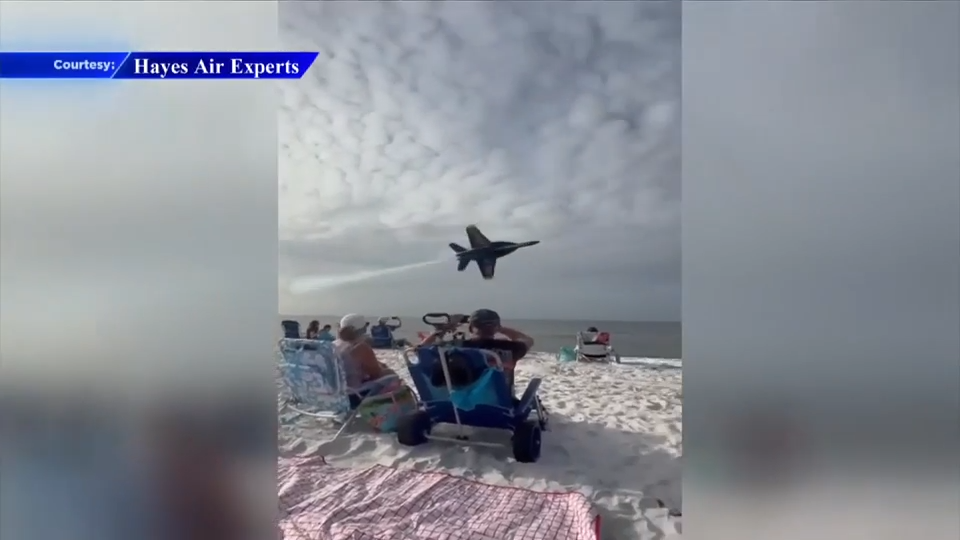
A social-media video showing a Blue Angels jet flying unusually low over Pensacola Beach during the “Breakfast with the Blues” event prompted an immediate safety review by the U.S. Navy Flight Demonstration Squadron. The clip shows a second aircraft passing closer to the crowd than standard arrival profiles, stirring sand, umbrellas and beach chairs but, according to initial reports, causing no injuries.
What happened
Video posted online captured two sequential arrival passes. The first aircraft completed a routine arrival, but a second aircraft made a lower-than-expected pass that created a noticeable disturbance among beachgoers. In response, team leadership announced it is conducting a thorough safety review to determine why the arrival diverged from published profiles.
“The U.S. Navy Flight Demonstration Squadron, the Blue Angels, is aware of social media footage showing a low-altitude pass by a team aircraft over Pensacola Beach earlier today. During an arrival maneuver, an aircraft flew lower than standard profiles, resulting in a disturbance on the beach that affected civilian chairs and umbrellas. The safety of our hometown community, spectators, and our pilots is our highest priority. Team leadership is reviewing the circumstances surrounding the maneuver and conducting a thorough safety review to ensure all operations adhere to strict Navy and FAA safety standards.”
Why the Navy reviews incidents like this
Safety reviews are standard whenever a flight demonstration or military arrival appears to deviate from established procedures. The Blue Angels operate under Navy and Federal Aviation Administration (FAA) standards that govern altitudes, approach corridors and spectator safety zones for both scheduled demonstrations and arrival/departure maneuvers near populated areas. Investigations typically examine pilot actions, communication, weather and aircraft performance data before determining corrective steps.
Local context and community reaction
Pensacola is home to Naval Air Station Pensacola and serves as the Blue Angels’ spring training base and headquarters, which is why demonstrations and arrival flights are frequent in the area. Even when no injuries occur, low passes over public beaches understandably raise community concern—residents and visitors worry about safety and seek clear explanations when routine profiles are not followed.
What investigators will look at
- Pilot radio communications and cockpit recordings for any miscommunications or deviations.
- Telemetry and flight-data records to confirm altitude, airspeed and aircraft configuration during the arrival.
- Weather and turbulence conditions at the time of the pass.
- Ground reports and video from multiple angles to reconstruct the sequence.
What to expect next
The Blue Angels and Navy review teams typically complete an initial assessment to identify immediate safety concerns and then follow with a more detailed investigation if needed. If the review finds procedural or training issues, the squadron can adjust arrival procedures, increase briefings, or temporarily modify operations until corrective actions are in place. Officials have stated transparency and adherence to safety standards are priorities.
Further reading and official sources
For ongoing updates and the official Blue Angels statements, refer to the team’s website and official Navy news releases. FAA guidance on airshow and demonstration safety provides the regulatory context for civilian and military flight demonstrations.
Sources:
- WSVN (local coverage of the Pensacola Beach incident)
- Blue Angels — Official site
- U.S. Navy — News and releases
- FAA — Airshow and Demonstration Safety Information
- Pensacola News Journal — Local reporting
If follow-up reporting becomes available from the Blue Angels or Navy with investigative findings, that material should be cited directly for definitive details about cause and any procedural changes.