


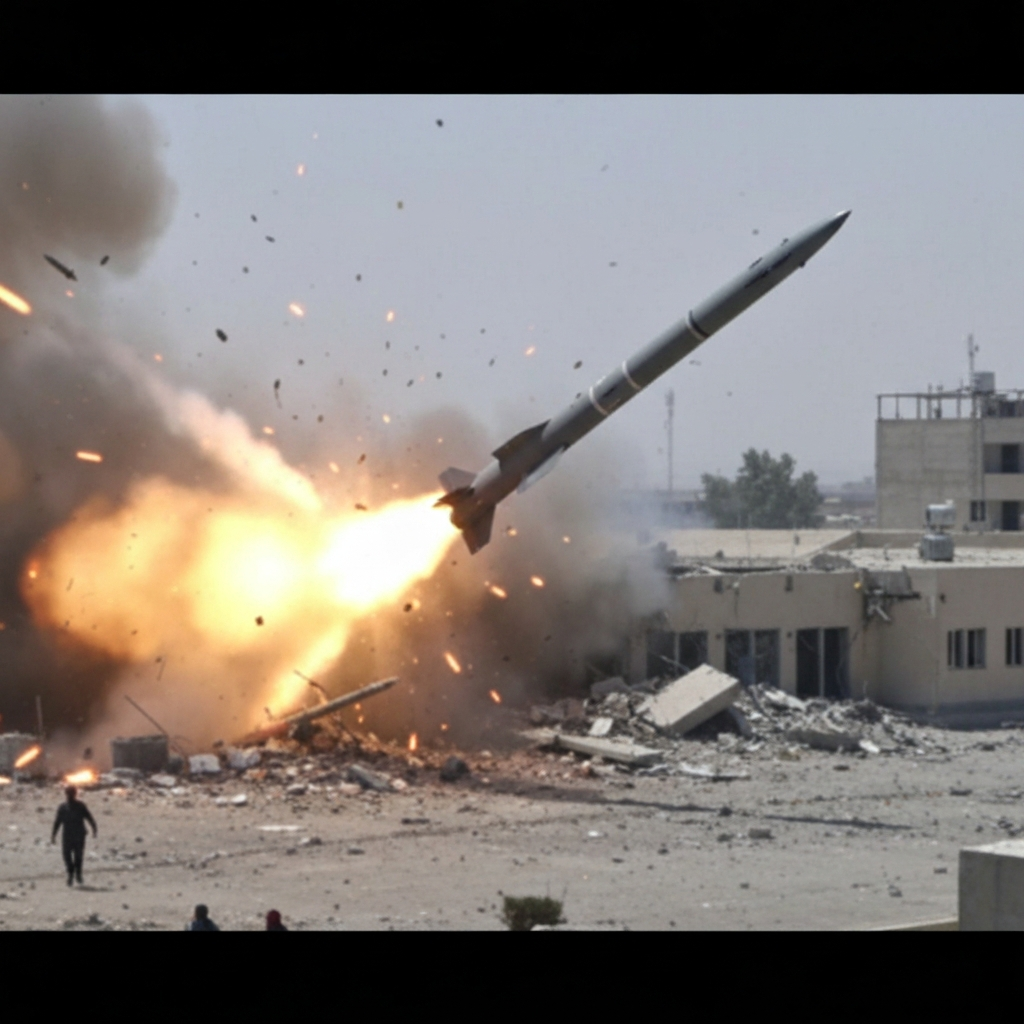
A newly surfaced video is adding urgent new evidence to the investigation into one of the deadliest civilian casualty incidents in the current Iran conflict. The footage appears to show a cruise missile striking a building inside an Islamic Revolutionary Guard Corps naval base in Minab, southern Iran, near an elementary school that Iranian officials say was destroyed in the same strike wave, killing more than 175 people, most of them young girls.
The story belongs in the World category because it centers on an international military incident, disputed responsibility for a deadly strike, and the wider geopolitical fallout involving Iran, the United States and Israel.
What the new video shows
The video, posted by Iran’s semi-official Mehr News and analyzed by independent researchers, appears to capture a missile moments before it slams into a structure inside the naval compound. The footage was also reviewed by major international outlets including The New York Times, which reported that it verified the video, and by analysts cited in CNN and ABC News.
Weapons experts quoted by those outlets said the missile’s shape resembles a Tomahawk Land Attack Missile, or TLAM, a long-range cruise missile used by the U.S. Navy. Analysts pointed to the missile’s cruciform design, wing placement and tail section as key indicators. Still, identification from video alone remains short of definitive proof, especially because investigators have not publicly recovered munition fragments from the school site.
Why Minab matters
Minab sits near the strategically vital Strait of Hormuz, one of the world’s most sensitive maritime chokepoints. The strike’s location — beside a Revolutionary Guard naval installation and near a school — has intensified scrutiny over whether the school was directly targeted, accidentally hit, or damaged by blast effects from a nearby military objective.
Satellite imagery reviewed by The New York Times showed multiple precision impact points across the base, including direct hits on several IRGC buildings. One structure in the school complex also suffered severe damage. Analysts told the paper the patterns were consistent with deliberate precision strikes, though that still does not conclusively determine which strike caused the school deaths.
Competing claims from Washington and Tehran
Responsibility for the strike remains heavily disputed. U.S. officials have not confirmed whether American forces carried it out. U.S. Central Command has declined to comment while the matter is under investigation.
President Donald Trump told reporters that, in his view, Iran itself was responsible, while Defense Secretary Pete Hegseth said the Pentagon was still reviewing the incident. Iranian officials, by contrast, have blamed the United States for the attack.
That uncertainty matters beyond the battlefield. If the weapon was in fact a Tomahawk, attention will remain fixed on U.S. naval operations and on whether Washington is withholding operational details. At the same time, analysts caution that public narratives in wartime are often shaped by incomplete evidence, selective releases and propaganda from all sides.
Broader global context
The Minab case lands amid broader international concern over civilian harm in modern conflicts and the difficulty of verifying fast-moving wartime claims. Recent reporting from Reuters World, The Associated Press and BBC News has underscored how satellite imagery, open-source intelligence and independently verified video are increasingly central to documenting military incidents when journalists cannot safely access the scene.
The use of geolocation, weapons identification and cross-platform verification by outlets and research groups such as Bellingcat reflects a larger shift in international reporting: visual evidence is often available immediately, but certainty arrives much more slowly.
What comes next
Without on-the-ground access, forensic recovery of weapon debris, or a formal public investigation accepted by multiple sides, the full truth about what happened in Minab may remain contested. But the newly surfaced footage has sharpened the key questions: what weapon was used, who launched it, and how a strike on a military compound coincided with catastrophic deaths at a nearby school.
For now, the video does not close the case. It raises the stakes. And in a conflict already defined by escalation, denials and mounting civilian casualties, Minab is becoming a test of whether international scrutiny can still produce accountability.
Sources: Straight Arrow News; The New York Times; The New York Times satellite analysis; CNN; ABC News; Bellingcat; Reuters World; AP World News; BBC World; U.S. Central Command.